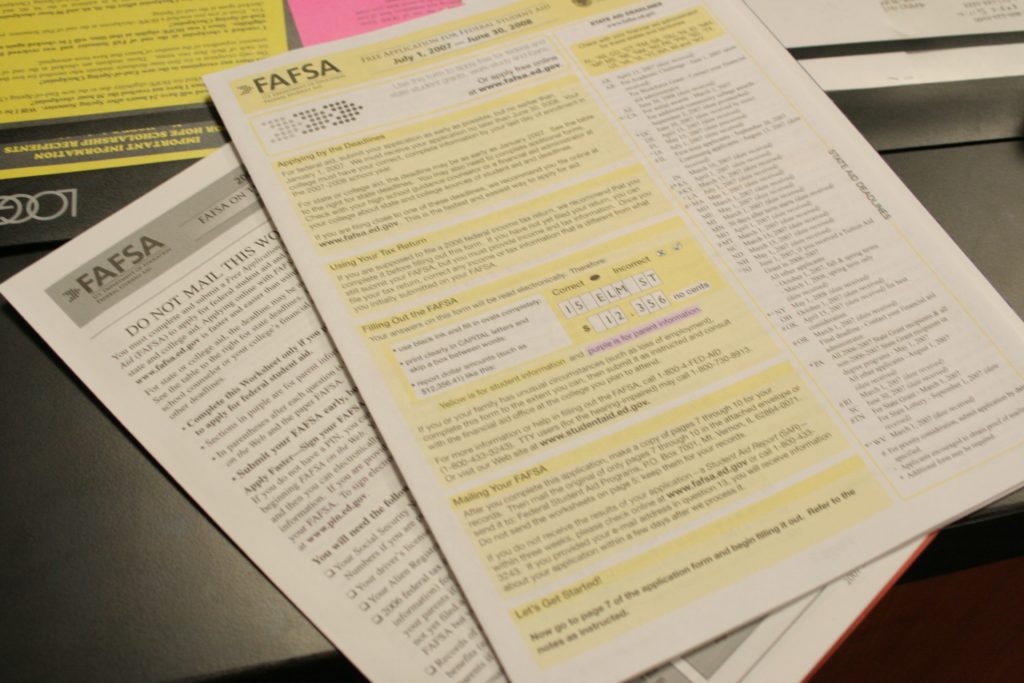
 Tax time is in full swing, and as usual, I’m sitting around waiting for my last few pieces of paperwork to come in so that I can do my taxes. Every year, I strive to get my own taxes, and my mother’s, done as quickly as possible so that I can fill out the Free Application for Federal Student Aid (FAFSA), a bane of my existence, in hopes of getting as much aid as possible (not that it has really helped in any of the previous years).
I have a special hatred in my heart of hearts for the FAFSA. I think it’s a broken system indicative of greater problems in the US Department of Education, but its own problems are great enough to set my teeth on edge every time I hear someone sound out “Faaaph-sa.”
Who’s Your Daddy?
The FAFSA puts a special emphasis on everyone being a dependent, which often scams a lot of students out of aid that they might otherwise receive. Got rich parents that refuse to pay for your schooling at all? The FAFSA doesn’t care – it doesn’t even ask if you live with your parents, just when you were born, whether your parents are alive, and whether you yourself have a spouse or dependents.
Here’s a fun example: my situation for this year’s taxes and FAFSA. The IRS does not consider me a dependent of my parents, because I am over 19 and was only enrolled in school for 4 months of 2007 (you become a dependent when you’re enrolled for 5 months of the year). However, the FAFSA doesn’t even ask if the IRS considers you a dependent – it just assumes I am. Left hand, do you even know there is a right hand, let alone what it’s doing?
I’m sorry if this comes off as an angry rant – I’m steamed, but in the same calm, already-beaten-down demeanor that I have every year when dealing with the FAFSA. I know it’s broken, but I also know that I have to comply with their awkward regulations and just do it, if I want any financial aid at all.
Ch-Ch-Ch-Changes (Refusing to Face the Strange)
The information the FAFSA uses to assess financial need for the 2008-2009 school year comes from your (and most likely, your parents’) 2007 income. Therefore, things like sudden job loss or disability or divorce are not taken into account, if they happened late in 2007 or early 2008.
Your combined incomes on paper may be $150,000, but if they’re suddenly dropped for any of those reasons, the FAFSA just doesn’t care – your financial need is that of a family making $150,000, not what you’re really making.
Siblings? What Siblings? We Don’t See Any Siblings!
A good friend of mine had smart parents who knew that the fact that they made a good living would make it hard for their three children to get financial aid. So they put aside a good chunk of money to send the kids off to college when the time came.
So when my friend, the oldest of the three, filled out the FAFSA, and found that it only asked how many siblings he had in college. He checked none, and the FAFSA assumed that all of the money his parents had set aside was for him. The story is different this year, with his two sisters both enrolling, but the financial gouge that first year caused to him to have to put off going to his first choice school, and attend community college for two years instead, and then transfer.
Which is not, by the way, to knock community college. For my friend, it was the best choice and seems to have served him well and he’s very happy now that he’s at his first choice school. However, this happy ending for him can not necessarily be replicated by everyone.
I, for example, couldn’t have done anything like that. I was gearing up for film school, a heartless program with few general education credits. If you spend two years at community college, it won’t save you a single moment in film school (at least at the one I attended, and many others) – no, the program is set up to take you a full four years, no matter what. But as I’m fond of saying since I dropped out of film school – it’s not for poor kids.
All In the Family
Odd family configurations are foreign to the FAFSA calculation. Sure, there’s considerations for divorces and non-parental guardians, but it doesn’t go far enough. This is one of FAFSA’s more ambiguous quirks: for some people, it’s actually helpful, but for other’s, it’s just another knock against them.
Got legal guardians who don’t actually provide you a home or any financial support at all? The FAFSA counts their incomes all the same. Have a non-legal guardian, such as the unrecognized same-sex spouse of a parent? Oh, well, the FAFSA doesn’t count them, unless they provide more than half of your support. (The take-away here? Not having marriage equality means children of same-sex couples may be getting a greater boost in financial aid – think about that!)
So What’s to Be Done (Other Than Seethe)?
On the personal level? Fill out the form diligently, and take your own initiative to talk to your school’s financial aid office about the particulars of your own situation. Also, put a certain amount of effort into seeking out private scholarships.
On the large scale, well, it’s all about Department of Education reform. Ask your representatives what they plan to do about the broken FAFSA – after all, you are their constituents!
Does anyone have a FAFSA or financial aid nightmare to share?
Photo credit: Bent Tree News

I had to deal with this all through college. My parents were not able to help me pay for anything, but I was still considered a dependent. When tax time came around, they were given “education credits,” because of the tuition that I was paying. Fortunately, they were cool enough to give me the difference.
My kid has worked so hard. Unfortunately as a single parent its been all I can do to keep a roof over their heads and food on the table. He wants it so bad he works 28 hours a week and goes to school full time. Let me make this clear. What upsets me is that I have worked my whole life paying taxes. Working whatever odd jobs on top of that too to get him in. So when Ms. financial aid officer over there posts how fair this is. How fair it is to take my taxes and give them to the family who doesn’t work?? To the ones who put in no effort??? Yea that’s fair.
I agree. Many of my friends quit their jobs and become jobless in order to have cheaper tuition and more financial aid. I find it so unfair that they choose to make us lazy as an incentive.
I hate the FAFSA. For my husband, there was no way to indicate that his parents were not able to give him ANY help (on paper, they made a moderately low income, but had a ton tied up in debt – they declared bankruptcy his senior year).
In my case, my parents were perfectly willing to contribute whatever their “expected contribution” was (I am grateful beyond words) – but the FAFSA hurt them when my dad took early retirement and they divorced in the middle of my education. The FAFSA doesn’t care that an income that used to provide for one family under one roof is now providing for three people, each under their own roof. Oh, and my dad retired Dec 31 of that same year, so that wasn’t taken into account, either.
I have no idea where they came up with the money for that year of education – I have a sneaking suspicion it came out of their home equity.
For me, my mom went through bankruptcy right before my freshman year, so she doesn’t qualify for loans, but the majority of my offered aid is a “Parent Plus Loan.” Every year she has to apply, get denied, and I have to go through an appeal process to get more loans. After that, there is still a huge amount of tuition that I have to pay out of pocket.
Asking if anyone else has FAFSA nightmares is akin to a rock band coming out on stage and saying “Who wants to ROOOOOOCCCKKKK???”
The FAFSA is a government form – guess what? You may not see eye to eye with the federal government on everything. But, at the end of the day, there are a lot worse ways that aid could be determined. You said that the FAFSA doesn’t take into account changes in your income going forward (job loss, change in marital situation, etc.). Neither does the 1040. The FAFSA takes a snapshot of your family’s finances on the day you file the form. If you know that – then you should plan for that. You wouldn’t head down to the Sears Portrait Studio to have your picture taken with your hair mussed and your clothes wrinkled. Well, why do people do that for their financial pictures?
Without nitpicking through every point (and you do have some valid ones) – I can only say that when you say “Got rich parents that refuse to pay for your schooling at all? The FAFSA doesn’t care” – I really have to wonder if you think that whatever limited resources are available should go to children of the wealthy, whose parents just refuse to pay for their educations. Do you think that a system that would reward that with aid has any likelihood of being abused?
I think your last comments were the most valid – and it is a shame that they got buried at the end of a rant. You need to work with the financial aid office at your campus to explain special circumstances. Every year, every financial aid office has to deal with special circumstances. There may be a committee that decides appeals – it may be the Director of Financial Aid or the VP of Enrollment Management (depends on how your school is set up). Your best bet is to be honest and straight-forward with them when you explain your situation (in writing) and meet with them in person. Embellished stories will not likely win you favor with those that can help you.
Lastly, I am very familiar with programs that are underfunded by financial aid (like your film school situation). Your comment was that “it’s not for poor kids.” Well, to some extent, that is true. It may sound harsh, but it really does boil down to the old adage that life isn’t fair. Not everybody gets to be an astronaut (or whatever your idea of the ultimate cool job is) when they grow up – and no one said that money should be provided for full funding for all programs.
It’s sad…but, it’s true. Good luck with your education – and I hope that you can get the message out to help people get financial aid.
@TravelinMan-
The flaw in the system is that it works just like any other ill-fated government-imposed welfare program. Call it what you will, but at the end of the day, it is just another way to redistribute moneys to those with lower income. It assumes that throwing money for school at someone who may or may not be ready or serious about their higher education will fix social injustices, etc. While I have many issues with other social programs that redistribute persons’ incomes, I feel that education is a worthy and sustainable way to spend tax dollars. That said, disbursement of federal education funds based solely on financial need is ridiculous. The Department of Education does not take into account the educational merit of its aid applicants on the FAFSA.
Two better possibilities exist.
In my opinion, all government-funded scholarship, grant, and subsidized loan programs would better serve everyone if they were largely (70% or greater) based upon MERIT. Everyone has an equal chance at an education from grades K through 12. Everyone has the same opportunity to work hard on their education and earn the qualifications for higher education. Sure, bleeding-heart liberals will cry if a few poor kids don’t get that free handout, but a lot more deserving and qualified students who would complete school and contribute to society will benefit.
Otherwise, allow the individual schools to handle their own applications. It is not possible for the Dept of Education to fully understand the financial situation of every applicant. Each school can determine for itself criteria for aid eligibility and better understand individuals’ financial situations.
@The Travelin’ Man,
Thank you for your comments – I was trying very hard to list the issues with the form without it becoming much of a rant, so I’m sorry for the parts where I did fail at that.
I suppose the main reason why I care about the “rich kids” who’s parents won’t pay is that I’ve had friends whose parents abused this. One friend, her parents wanted her to live at home and commute to a school of their choosing. They refused to pay for any other school, knowing full well that their high income and assets would make it, frankly, impossible for her to stake out on her own and go where-ever she should choose.
I know that a lot of people think that this IS fair, since the parents are footing the bill. But I feel that they are taking advantage of a bias in the system, one that simply assumes that all rich parents are going to foot the bill, and makes it extremely difficult for anyone under a certain age (23 seems to be the magic number for the FAFSA) to declare themselves independent of their parents.
Now, I’ll also admit that I don’t exactly have a solution – it’s not as if I have some better form with a better calculation sitting on my desk here, waiting for the DoE to adopt it. But, I would like to know that they A) Know of the problems and B) Have people working on them.
I am so so so happy I don’t have to fill out a fafsa anymore! (unless of course I decide to go back to school) I was pissed about being considered a dependent! I moved out of my house when I was 18 and was supporting myself for about 2 years before I went to college. My mom wasn’t even in the same state as me anymore!
The only good thing was that my mom made no money and had no money, so in the end, only my info counted. But I still had to go through getting all her info every year and…the worst…verification. Every year I had to go through it (she had no income, just took care of my grandma, so she didn’t have to file taxes) Get called to financial aid, call mom, have mom find away to get to fax machine, sign form, and send back. And if you knew my mom, that is about 50% harder then it sounds.
But thats not as bad as it could have been. I had a friend whos parents refused to fill out the fafsa. They didn’t want her going to school to effect them financially in any way. Lovely.
My 21 year old makes more money that I do and she moved out and we don’t pay for anything of hers…but according to FAFSA she has to file as a dependent. Ridiculous. The system is screwed up. She wants to go to college and but doesn’t qualify for scholarships (no financial need) and she maxes out with student loans but can’t get any other loans. System is broken.
Travelin’ Man – the 1040 and the FAFSA are both financial snapshots… but the 1040 is specifically for the year that just passed (assessing taxes), while the FAFSA uses the info from the past year to determine FUTURE aid. Major changes to income (divorce, illness, death) can’t be planned for. In the end, they penalize you twice – once in the year when your income drops (can no longer afford the same level of financial aid you could at the beginning of the year), and then AGAIN the next year (because the drop isn’t fully accounted for).
I think the other points you make are good. The FAFSA isn’t the endpoint – most schools’ financial aid offices are willing to help out students to allow them to stay.
You post brought back memories for me. I totally agree that the FAFSA system is flawed.
I dropped out of school two years ago, moved 600 miles away, became employed full-time, and am now ready to go back to school. Now I’m f***ed on the FAFSA because my parents both work and my own income was just over 30k… I haven’t filed yet but am pretty sure I’ll get dick.
My mother makes less than 20K a year.
My father and I haven’t spoken since I was sixteen.
Easily the most book-smart of us children, I went to college at the young age of 16 on a government grant for two years.
I’m 25 now – Quite honestly, I could have had my masters by now, if it weren’t for the FAFSA.
Even IF they only considered my mother’s income, I’d still be a dependent, even though I’ve been on my own since I started college.
How ridiculous, right?
@Amphritrite – No, you would not be considered dependent. For the purposes of financial aid, you are considered independent when you reach the age of 24. If you are already 25 y/o, then you are considered independent for the purposes of financial aid.
That said, even if you are considered independent, it doesn’t mean that you won’t have an EFC, and it doesn’t mean that the school you are looking to attend will guarantee to meet need beyond the point of your EFC.
Lastly, the rules for financial aid at the graduate level are very different for the rules for undergraduate studies. You may want to consult the financial aid office at the school(s) you are considering. Honestly, the best opportunities for graduate financial aid come from the academic departments at your school – grad assistantships, research opportunities, etc.
@ The Travelin’ Man,
You’re right about the grad school aid and the over-24 issue, but what I think Amphritrite was trying to point out was how they considered both of her parents’ incomes during her UNDERGRAD studies, even though she was independent of them.
I am in a situation where my parents flat out refuse to help me with fasfa. My father, who is the wage earner in the house, has not had a job for four years, and told me the only reason why he has filed taxes before so is I can get financial aid.
now he’s not going to, and im not going to be eligible for aid. I agree with your article 100 percent.
As a financial aid employee, I can certainly empathize with your situation and feelings, but of course want to point out a couple of other things that Travelin Man – who seems to be really knowledgeable about this too- didn’t mention.
First of all, the ONLY money on the federal level that you are eligible for as an independent is $4000-5000 more in UNsubsidized loans per year. Is another $20k of interest earning debt really worth the headache of wishing you could be considered independent? (of course the alternative of $20k of private loan debt is much worse…)
Secondly, a big reason this rule is in place is because people are dishonest. Even if a student could prove that they support themselves and claim that their parents wouldn’t help, there is no way to know this for sure unless the feds or your school monitored your wallet or your bank account. I don’t think anybody wants this.
Unfortunately I agree that federal financial aid is a system in need of help, but in the face of rising college costs and enrollment plus our doomsday economy, it’s going to be difficult to come up with successful alternatives to what we do now. I strongly encourage anyone upset with the process to develop a positive relationship with their financial aid counselor and/or office. If you put in the time and effort into this instead of complaining, you’re likely to be treated much better, and possibly be considered for certain opportunities over others first.
You mean trust people? Like when I fill out my tax return?
There are laws against lying.
As a financial advisor, then obviously you must understand where we are coming from. I am 19 years old, graduated high school last year, and am attending my second year of college. I was forced into it by my family, who didn’t want me to turn out like my 26 year old cousin that still lives at home with mommy doing whatever he needs. It was “get in school or get out.”
I don’t have the money to pay, having lost my job that barely past minimum wage by a few cents. My family has no intention of helping me pay, despite forcing me into school. They don’t have the money either, as it goes towards living expenses and other bills. I paid my own taxes, and while I live with family I pay rent to them and buy my own groceries and pay my own bills.
I’m only 19, but I am already 7,000$ in debt because each year was 3,500$ that I needed loans for because my mother’s income was too high for a scholarship or grant. And this year it was a pain to get her to just agree to fill out the fasfa.
If she hadn’t, all I’d be eligible for would be loans because I’m still a “dependant” so I wouldn’t even have gotten a chance for aid had I not convinced her over several months to fill it out this year. And now I have to get forms submitted to the school that takes weeks to process to accept the loans for this year, and if they aren’t accepted in time I will be dropped. And being dropped means that the loan I take out I would have to pay back in full. An unemployed 19 year old who hasn’t even been able to build up credit with no help from family cannot afford to pay back a 3,500$ loan in full and make payments on a previous 3,500$ loan at the same time with 300$ in checkings and 200$ in savings.
Do you understand? Because I’m a dependent of my mother, who despite losing her job three times last year still makes too much for aid, I can’t even pay for a cheap community college because my income isn’t taken into account. I CANNOT get aid unless I marry, have a child, or turn 24. 24! When I’m legally an adult at 18 and can no longer be claimed by my family on taxes! Do you know how much debt I will get in the next 5 years? And what happens if I don’t get a job, or a good paying job after school? Or I want to transfer and get a bachelors? My life hasn’t even started and I’m already drowning in the debt because FASFA thinks my mom pays more than a third of her income to me for school.
Preach, preach
I have had this issue every year that i’ve been in school. I have 10 more months until the fafsa considers me an independent based on my birth year alone. I have been on my own since I was 18, and have been working full time and going to school ever since. But i’m a dependent? PLEASE!
I don’t understand why the government would not help people that actually need help. I’d get more help if I had a child, or got married, and those are things I’m not ready to do. I’m also not a minority, so I don’t get any of those benefits either.
Something should be done for the rest of us!
I was searching the web for what to do after filling out the FAFSA and being told I’m not eligible for grants…and low and behold I found a fellow student with the same angst for the FAFSA that I have.
My parents have in the past paid for school, and took the $5250 tuition reimbursement from my job as payment. [Though, the $5250 is for one calendar year, so if I turn in my grades in january and get all of that money back, there’s no reimbursement for that Spring or fall semester that follows].
Recently my parents have fallen on hard financial times, while I’ve moved out and become independent by IRS standards. So for the first time ever, I filed my taxes seperate from those of my parents.
I had filled out the FAFSA the summer of 2003 after graduating high school and was told I’d get nothing fromt he government, so when it was time to fill it out again (now that tuition falls on my head and my head alone) I expected a larger payout since only my income was supporting my education.
Unfortunately enough, I wasn’t born before January 1, 1985 and thus had to include my parents information.
Once again, the government has bent me over and laid in without lube. ::painful::
I’m struggling to find scholarships whose deadlines have not passed, and are open for part time students; since I’ve held a full time job since 2003 at the same company.
I agree, the FAFSA is broken, they should ask if you filed taxes seperate frm your parents, whether you are financially independent from them otherwise. Your school’s financial aid department can’t do anything for you except give you a sheet of paper that has websites full of scholarships that require you to be a full time student or incoming fershman.
What about the adult learner?
What about the people who just want their degree?
Another punch to the face of the middle class…thank you FAFSA…and thank you Uncle Sam.
I just found this too.
I’ve been devating on this since I’ve filed my FAFSA again after dropping out of college for 3 years and moved state and now returning again on fall(I’m 21 and will be 22 by fall) on the state that I reside now.And parents refuse to help with my tutition since theres no LAW forcing them and Legally, they plainly dont have to.
I’m one of those students that been on their on for years without parental help.Hell, I’m even 21 and almost 22 years old; which passes the age of legally minority and I’m still considered “dependent”. This is a insult thrown to my face and more reason for me to hate this goverment and future criticism points when it comes to its downfall.
Really, does the goverment wants our legal Adult age to be 21 or 24 or older? Make your fucking mind up, please. To me and most people, a Adult is a independent humain being. Thus 21 is the minimun age to have and be awarded that definition BUT the FAFSA thinks otherwise.
Now I’m stuck with my only choice of loans. And taking loans is a step forward and backwards at the same time.
I might as well hold out, take a cheap loan and do 2 classes a semester until I’m of age. Yessh. Talk about torture.
My only option to speed things up is declaring “Abandoment” from my parents. And yea you have to go through court and lawyers for that, so its better to do the waiting game.
The government decides your age of adulthood based upon its own needs…
18 years – Join the military! Pay taxes!!
21 years – You can drink now! Keep paying taxes without benefit!
24 years – Now that you are out of school and no longer need money for education, just keep paying your taxes and drinking that Kool-Aid.
…….80 years! Now you are dead and have paid thousands in taxes on your lifetime income… But wait, your kids never had that much money did they? They can spare a little for the poor… They should pay a tax to get your money!
My mother got re-married to a very bad person and I left at 18 and haven’t had contact with them since then.
I work 50+ hours a week and go to college full time. I’m struggling like heck to keep my grades up.
I really can’t afford to pay for my entire college out of pocket. I’m physically drained and I still can’t even afford to buy my school books.
Yet according to the FAFSA I am a dependent.
I hate the goddamn FAFSA.
I’m in a similar situation, of age to be declared financially independent by all other standards but FAFSA. My parents didn’t help me pay for school even when I lived with them, but since I was still technically a dependent I had no complaints. However, now I don’t live with them, in fact we live on two different coasts, and am working temp jobs just to get by. Yet I’m a dependent. I have no idea how I’m going to make tuition payments. Thanks FAFSA.
The federal govt assumes your family has the responsibility for meeting your college costs. They were the ones that had you and could have been trying to save up all this time.
If there is ever any changes in your parents marital status or financial status, contact your Financial Aid dept at school. I work in the financial aid office at a college, and we always take unusal circumstances into consideration, but we don’t know about them unless you tell us!
There are a lot of aspects of the FAFSA that do not work for everyone. However, coming from the other side…I see a LOT of people trying to scam the FAFSA.
The FAFSA asks parents age so they can take the retirement factor into consideration. If your parent takes an early retirement, you must let the FA office know at your school.
The rich parents thing: See how many parents make over $200,000 per year and still feel entitled to grants. This country doesn’t have the money to send everyone to college – free of charge.
If students could become independents and get grants just because they don’t live with their parents, then all kids would move out before starting college, and they would all be independents. There has to be limits.
The IRS – Internal Revenue Service – is an entirely different entity than the Department of Education. Just because it’s the govt, doesn’t mean they have anything to do with each other. One office deals with income / the other, education.
It does not matter how you file your taxes. It could be that you do live with your parents, but work & claim yourself. It could be that you don’t live with your parents, and they still claim you. Your parents may be split up and have had joint custody of you the previous year, and only 1 parent claim you on their taxes – you could have a different parent file the FAFSA. So the Dept of Ed doesn’t care how the taxes are filed – it has nothing to do with dependency for financial aid purposes.
I see a lot of BLAME being put on the FAFSA. No one has to fill it out. It’s not a requirement to go to school. Just to request financial aid.
I want to go over all the topic s and replies, but it would take forever. I would definitely tell Jane to go to see her FA advisor. She could be considered estranged from her mother and then be an independent.
They do set a limit with the age because, again, there has to be some guidelines. That is also why the individual schools do take extraordinary situations into consideration.
The complaint that someone with parents in a same sex household may get more money. I understand that. There are also people who live with their mom & her boyfriend / or parents getting separated – just because of the FAFSA. Not all schools ask for court documents on the separation. Our school does not. We just need separate W2s so we can separate the income & change the FAFSA to only one parent.
Ahh, more FAFSA pain.
I just found out that my friend, who makes $20,000 a year more than I do… (I make about 20k before taxes) got tons of PELL grants. I’m wondering if it’s because her parents are divorced, and she gave the tax information of the one with the least money.
This is frustrating for me, because I live in low income housing, have been paying all my bills since I was 17, my parents haven’t claimed me on their taxes since then… hell, I was homeless for 8 months when I was 20, and my parents even knew about it. They would see me on holidays and act like it was no big deal.
Anyway, I am planning on heading to the Financial Aid office tomorrow (because it is still open by the time I get off the bus from work), and hope that something can be done. Otherwise, I’m paying out-of pocket for everything, while working 40 hours a week or more (M-F, 7-4), and barely scraping by… for the next two years, until I finish my associates and am 24.
Has anyone considered protesting? I would be interested in doing so. My story is much like the others posted here.
When I was a senior in high school, my high school filled out the fafsa and sent a partially completed copy to my house for my parents to fill out their financial information. I was told that I HAD to have the FAFSA filled out to be eligible for the scholarships they were nominating me for.
I asked my mom if she recieved it a couple weeks later to find out it had gone straight to the trash. My problems have escalated from there.
I ended up spending the first two years of school at a community college, which lost me a great ammount of credits in transfering.
At university, my EFC turned out to be 64000! The only thing my parents have contributed thus far is cell phone bill and car insurance, hardly enough to call me a dependent. I’m also under their helath insurance plan, but they recently told me not to use it when I tore my ankle up. I work and recieve merit-based scholarships in order to support myself.
Every year the school sends them an education tax credit form… I can only wonder how much they are saving because of it.
It pisses me off because my ex girlfriend was bought a house, an infiniti, and a tahoe upon graduating from highschool. She filed the FAFSA under her mother’s income, and recieved the full financial aid package.
I will only contribute donations to the scholarship organizations that have helped me get through school. The only real way to help someone is to offer merit-based money.
I can only hope the government will abolish the FAFSA. After all, we would save money on taxes. It’s unfair that a factory worker has to pay taxes to help a rich kid purchase an escalade while studying some artistic BS.
Here is a true unfair-ism of the FAFSA (more than just “i am over 18 and my parents don’t support me”):
I am 21 years old now and had my son when I was 18. My son, his dad and I have all lived in our own house and have payed for all of our own expenses since my son was born. We are not married, (yes i know that is the easy solution to my problem) right now it is just not possible. Now I know what you are thinking….”you have a dependent, the fafsa should consider you independent” but no…..because I only made 10,000 last year and my boyfriend made 13,000, the little clause on the dependent question that says “Do you support a spouse or child 50%” bites me big time in the butt. My parents have no reason to help me, they love me but i am a 21 year old woman with my own family. It’s pretty crappy that I can have my own dependent but i am still my parent’s dependent. Every other government agency can consider me independent but nope, not the important one. So anyway, if anyone else has a similar story or if anyone thinks this might be a “special circumstance” according to the all mighty financial aide board, please comment back
This is not a special circumstance. You just should have answered the question on the FAFSA as “yes” for you supporting someone 50%. I am a Director of FA for a University. That is what you should have done. Thanks.
Wow…you should have put down that you support your child 50%. That is common sense. And no, its NOT cheating the sytem. It would have made you independent.
In fact, I have 2 children and am an UNMARRIED STAY AT HOME MOM LIVING WITH MY SIGNIFICANT OTHER.
My school told me to “put down that I contribute more than 50% to my children.” In fact, they said, because we were living together and sharing expenses, we BOTH contributed “half because we lived together and had shared income”….REGARDLESS of what we made together.
No offense, but MAYBE instead of complaining about how much the FAFSA sucks, YOU should have contacted an aid advisor. It’s the common sense thing to do when you aren’t sure. Bc you just screwed yourself out of a free 4 year education.
Oh God, do I ever have FAFSA nightmares. While all my friends had mom and dad, my parents were trying to get by on $500 a month, but according to FAFSA, they still made enough to take away any aid I might have gotten. That is why now that I’m 25, I’m going to be a freshman. All of my friends are about to graduate if not already graduated, with thousands in debt. I’m the slacker who kicked back for 4-5 years, got a job and waited until I qualified as independent.
I also have to mention that in my brother’s case, he’s just now 21 and they still can’t afford college. I feel for the poor kid, but I’m having enough of my own finance worries I can’t help him except tell him to do what I didn’t. Start a savings account and scholarship hunt himself into a mental stupor.
So far, 4 years running, I’ve been “randomly” selected to fill out extra verification for my entire FAFSA through my school. Basically I have to fill out all of the same information twice, despite having yet to get anything wrong either time. I fully expect it to happen again this year as well.
@Megan – the same thing happened to me, only it wasn’t random. I was singled out for verification every year because of having such a low parental income – but that’s because the FAFSA only counts my mom’s income, not any of my other parents’ (long story). Is it possible you’ve been singled out for verification because of low income? (You don’t have to respond if you don’t want to – just something to think about.)
If that’s one of the criteria for selecting people for that then that’s very likely, I just find it annoying that each year the emails still make it seem like it’s random.
yeah similar problem i decided to go back to school iam 21 the fafsa didnt give me any aid and honestly my step dad made like only 44,000, and that year i made 28,000 but yeah i lost my job i live on my own pay my own gas, electric, rent, and yeah its a little selfish but time warner{cable} i dont have a cell phone i have the house phone and interent, um i do smoke i like to have clean clothes i do like to eat at least once a day, plus gas just to drive your piece of junk car that oh yeah the parents didnt pay for either, and what about insurence to drive the vechile , fafsa sucks it should really ask more questions that provide equal oppurtunity no matter what age, and consider that yeah most people have there own bills and arent rich washington folks that have mommy and daddy pay for everything
I couldnt have said it better myself.
I just finished filling out my fafsa for the 2009 school year. Luckily I am a non-traditional student, so I no longer have to deal with the fact that my parents were never able to provide a cent of help when I tried to go to college several years ago. However, last year I made $48,000 and this year I’ve been laid off. The economy sucks, and it’s unlikely I’ll find a job that pays over $12000 any time soon. The ridiculous part is, I would like to go back to college to finish my degree and expand my options for jobs, but FAFSA does not take into account that I am jobless THIS YEAR, instead, it uses the EIC from last year, which makes me inelligible for a Pell Grant. It is the most idiotic method of determining need I have ever seen. I’m broke, struggling, and can’t even get help to go to school because things weren’t as bad last year, when I didn’t need the help. It’s ridiculous. Anyone with half a brain should know that this causes those of us that need help with our education expenses to be completely unable to actually get the education we need in order to get the jobs that would help us pay for it. Talk about a catch 22 – the FAFSA is idiotic.
I’m sorry but you are very much mistaken. Correct, you do need to file the FAFSA with last year’s income HOWEVER you may go to the Financial Aid Office at your college or university and tell them that you are not working as much or making as much money as you did the prior year. At the discretion of the financial aid office, they can change your FAFSA (only them – not you) to reflect the current years’ projected wages. So no, FAFSA does not take into account income changes, BUT financial aid officers DO and FAFSA allows them to make changes to the income for reductions.
I am a Director of Financial Aid for a state University.
blah blah blah. ^_^ i hate this. 1) i am 20, so i either have to wait until i’m 25 to GO to college or somehow get my parents to help… my mom is going to college herself, and i know that their income is alright, but def not able to support two people going to school. 2) i moved out when i was 19, doesnt that whole year of supporting myself count for anything? 3) i am labeled as a dependent on FAFSA, so why cant i get health insurance through my parents? because i’m not a full time student… anybody else see conflicting issues here?
Ugghhhhhh…… people wonder why education is so much lower in the United States compared to other countries! I’m 22, have lived on my own since the age of 17 with no help from my parents. My mom owns a small business and will not file until the end of April and lives over an hour away from me. She also owns her own business so the financial aid office at my school has me come in atleast 3-6 times every year with information on my mom just for me not to get any financial aid except student loans. If I call them it takes over an hour on hold to get ahold of someone and then they don’t know what they’re talking about. My dad lives in another state and won’t file his taxes because he thinks the IRS will find him. So either way I’m screwed. Anyways the law needs to have exceptions for those of us trying to make a better life for themselves then their parents. Doesn’t make sense!
At least I get some aid rather than none for filling out the FAFSA?!!?
Not at all! I haven’t been able to receive ANY financial aid because of what my parents do with the FAFSA. They won’t let me get involved and believe me, I am starting to get sick of trying. Oh well, I am about to enter my fourth year…
Reason why I couldn’t get aid last year was because my parentals took out several thousands of dollars in an IRA just to make ends meet for that year. There were hefty medical expenses that needed to be paid as well. Just a bad year. But FAFSA doesn’t recognize why the amount of total income doesn’t match with what was made by my mother… therefore: NO AID! Not even a loan.
BLAH! “Its not perfect but, at least you get some aid out of it”?
Think again.
EVERYONE regardless of income receives some type of federally funded financial aid from filing the FAFSA. EVERYONE. A single person making $500,000 per year still qualifies for a low interest non-credit based loan. Is this not considered financial aid? Apparently not by you. The most common misconception of Financial Aid is that it is “free money”. Where can you go, today, and receive a NON-CREDIT BASED LOW INTEREST OR NO INTEREST LOAN that you don’t have to start making payments on for at least 2 1/2 years??? To me (and the majority of the rest of America) that is Financial Aid.
Hun I’m going to tell you this; getting a loan at 4-6% interest is not low when it immediately starts to accumulate even though you don’t have to pay it back for 2 1/2 years. With most costs in loans being over 30,000 and not being to pay them off for a couple of years, the money really adds up.
CHEAP universities ($6,000 or less a semester) and working full-time every other semester are the way to go it seems….. Just thought I would clarify because I know someone out there would read my comment and ask: ‘If you don’t receive any aid and the situation is truly as bad as you are making it sound, how are you able to go to school?’
My girlfriend is dealing with this situation right now as a high school senior. Bottom line is her dad makes a lot of money but refuses to pay. The best school she got into was an expensive private school and her parents’ EFC is 60,000. All that was offered to her from the school were loans. Unfortunately, based on all the cases I’ve read, this is all too common. FAFSA as a way for universities to divy out financial aid is completely unnessesary and harmful. I’ve read at CATO that for every dollar spent in financial aid, the cost of tuition goes up 76 cents. Bottom line is if financial aid didn’t exist, college would be exceptionally cheaper for everyone and students could afford to pay for it on their own if nessesary while avoiding thousands in student debt. The federal government treating individuals like numbers instead of human beings??? Who would’ve thunk!
There’s a little thing called Professional Judgment that could have helped you. You should have spoken to a financial aid rep at your school and explained the situation. The FAFSA isn’t as black and white as you make it out to be.
@mK: You may notice that in the article, I said “So What’s to Be Done (Other Than Seethe)? On the personal level? Fill out the form diligently, and take your own initiative to talk to your school’s financial aid office about the particulars of your own situation.” Although unless your situation is particularly unusual, most financial aid officers have heard it all before. It depends on how heavily the school relies on the FAFSA (in my case, it was quite a bit, but other schools are different) and it also depends on how early you talk to your financial aid officer.
Remember that Professional Judgment (referred to as PJ in the federal financial aid handbook) is somewhat limited. Although the school can give as much additional aid as it wants from its own coffers, it can’t use PJ to increase federal aid in the absence of “special circumstances,” and most issues of dependency do not count as special circumstances.
School full time, 2 jobs full time and i make about $12,000 a year. My rent is $750 a month and that leaves me with about $250 a month. For all my bills, including school since FAFSA thinks my parents money somehow applies to me. Well it doesn’t and I don’t qualify and I get no aid and I am hella poor. I’m pretty sure if I had a baby, no job, and lived off welfare I’d get all sorts of student aid.
My daughter is starting college in the fall. So is my stepson. According to the FAFSA, our EFC is $20,000. for my daughter. My husband is a school teacher and I made $24,000. My husband’s ex-wife just refuses to work. She is educated and capable, but will not get a job. She owns 2 houses (is supported by her current husband), received $10,000 in child support from us last year, and my stepson is going to college for virtually nothing!
Why do we reward the lazy? I go to work every day (apparently ONLY to pay for my childs college) and she sits around soaking the system and we reward her for this? There should be guidelines for assistance, like…..why don’t you work?
My daughter will not be going to her first choice college because we can’t afford it! Meanwhile, my stepson gets to go to the most expensive school in the State of Michigan because his Mom chooses not to work.
I have also been asked for verification. I live in an average house, don’t have any debt, because we are responsible adults who live frugile lives. Where is the justice?
Everybody should have to verify their income. How is it somebody can own 2 homes. One is a block from Lake Michigan (you can see the Lake from your driveway) and the other is a rental earning $2000 a week all summer. How is it their EFC is lower than mine?
right now i am a college freshmen in a community college and applied for FAFSA. all i can say is that it was a nightmare of papers. even though i am happy that i finally got the money after waiting for a long time…it seems unfair.FAFSA has a system that doesn’t make sense. my best friend was denied because her parents made enough…that is somewhat true but her parents have a lot of expenses more than my mom.
can i get a student loan even if i dont qualify for fafsa?I am 43
I have a horror story.
I am twenty years old and have been going to college on a scholarship since my sophomore year of highschool. My mother ended up getting heavily into drug use, and I had to move out while I was only 16 right before I turned 17. I ended up taking a year off of college, and was no longer eligible for my scholarship.
That’s fine, I thought, I’ll just get financial aid…. if anyone is deserving of it it’s me. I’ve been taking care of myself since I was sixteen, my mother ended up in prison, and I haven’t talked to my father since I was 13. I don’t even know where he lives~~~~~
HA HA HA!!! Try explaining to financial aid that your mother made NOO money at all in 2007 and you don’t know who your father is, that your mother can’t come into the office or sign a paper saying that she was incarcerated… because…. she’s incarcerated…
That you have no idea where your father is… they told me to find him… the last words my father said to me was that he hated me and never wanted to speak to me again… his life was better without me….so yeah… no I’m not going to contact him.
I had to ask the prison for paperwork that my mother was incarcerated which took three months to get, and then still I had problems….
pretty sure I have the best story…. and it only got worse from there!!! I’m just tired of whining now lol
Oh, and please nobody write back telling me to file for child abandonment or any other form. Going through highschool was hell enough without having a parent to sign permission forms…. so believe me– I tried it….
Lawyer fees if I wanted it actually done…. around four hundred dollars just for the paperwork to fill out by myself…. and I was told by a lady in the court room that it would be just wasting my time. That in Arizona the judges rarely EVER will make you a legal dependant at ANY age, no matter how crappy your parents are, and also told me to be careful because I might end up getting sent into CPS custody since I was so young with my mother in prison….. um…..yeah….. no thank you….
@Leslie- you stepson should have filed the fafsa using his mother and her husband’s info. since she is married and he supports her, he should also be on the fafsa. so evidentally, they are scamming the fafsa if he’s getting grants.
@pamela- fafsa is the application for grants and loans. since you’re an independent, you can get at least unsubsidized loans (earns interest). freshmen=$9500 loans per year; sophomore=$10500 loans per year; junior/senior=$12500 per year.
@Brittany- it’s your school that is being unreasonable. schools are entitled to use professional judgement in cases such as yours. i’m sorry for your troubles, but i do applaud you for going to college and working hard, regardless of your situation. you should check into outside scholarships at http://www.fastweb.com; or http://www.scholarships.com; or depending on your state, check their coordinating board website. if you’re in texas…here’s their site: http://www.hhloans.com/cfbin/tofa.cfm?Kind=PGS
Also, check with the department of your major at your school.
Good luck to you.
I agree completely with the need for reform. What is mind boggling to me is how I am supposedly part of my parent’s household… my brother is also part of my parent’s household, (and attends the same college as me); however, on our FAFSA we are not considered under the same household (because neither of us receive more than half of our support from our parents). Is this mathematically sound?
it tears me apart to hear all of your stories. all this time i didnt know you still need your parents info living with them or not to get a loan if you are under 24. i applied for west-wood last november and i talked to the advisor. he asked me about myself and after he needed to talk to my mom. now i find this funny how my mom says “no im grown” so no west-wood for me. yea, i guess that make a lot of sense. a few months passed by and i said i would have graduated from college by now. then my mom replies…. i dont wonder why your at school. that really made me upset. and the worst part is my mom is a know it all. so a month ago i went to a community college and got everything done, except my fafsa i got done with that, and they mailed some forms back to me. so i called them and they told me i needed my parents info. so now it looks like im not going to college until im 24.
ok, my parents are divorced. my dad is a non-tax filing drug-addicted piece of crap who left before i was even born. my mother dumped me off on my grandparents and only took me when they would fight. on top of that, when she would see me, she was on the abusive side. child protective services came to our house at least once a month. when i turned 18 she literally pushed me out of the door, spit in my face, and told me she never wanted to see me again. Now that i’ve been on my own for over a year, and am trying to back to school,i can’t. my mother apparently moved, and my grandparents know but won’t tell me where. i am in the process of the override procedure, but they said im very unlikely to get it because there are no police records, and CPS shreds all of their documents after so many days. so needless to say, it has been HELL for me trying to get financial aid, and private loans are out of the question. yet i see all my friends going to college, almost fully cvered by FA. So thanks to the fafsa, im screwed. Screw the Dept of Ed.
to add on to my comment above, im 19, living with my boyfriend and together we dont even make $25000 a year, both working full time. I dont think I should have to get married, have a kid, join the military, or wait years just to be able to get financial aid! they told me i could file abandonment, but with lawyers and court costs, it would cost more money than i make in a month! and forget private loans, i have no credit or cosigner! im really starting to hate this country.
Rachel, your story is one of the many that have come to the surface in these comments, and they all break my heart. It also makes me glad that I wrote this post in the first place: stories like yours need to be told for people to see how broken the FAFSA truly is.
I wrote a post a while after this one, on how to file the FAFSA without your parents’ info. I hope it helps you: https://poorerthanyou.com/2009/04/13/how-to-file-the-fafsa-without-your-parents-information/
i did read it 🙂 unfortunately they all tell me to fill out the override form. it’s been denied by 7 different schools, and now im just waiting to hear back from another. but it is absolutely ridiculous that the government would allow a horrid system to stop a few liers.
I’ve got a pretty good FAFSA story…
I’ve been going to CC for 2 years, and I’m currently 22. Filed FAFSA, and got an EFC of $13k. Both my parents combined make ~$70k, which I thought was middle class….so why such a high EFC? Nevermind that stepdad has been unemployed for the last 7 months. Or maybe it’s cause I work and live on my own? yea that makes me ssssoooo rich…
So, after cashing out on loans, the chair of the STEM scholarship committee comes to our class and tells us about this great scholarship. I apply and write the essay and turn it in. I feel pretty good about nabbing this scholarship. There’s 30 of them, my GPA is ~3.5, and there’s only 8 people in my Calc 3 class. Haha!! Merit-based aid at last—
Hold on there buddy! There’s just one problem. It turns out you’ve been disqualified because of your financial aid.(???)
…But how can that be? Was it cause I cashed out my student loans? Maybe I could get a waiver!
One hour later @ financial aid…Hmmmm, I’m sorry sir, but it seems your EFC is too high. What? My EFC? wtf does that have to do with a National Science Foundation scholarship? Well, it appears their awards are based on financial need….and they use the FAFSA to determine that financial need.
The FAFSA is such a crock of shit. On top of getting screwed out of grants, you get screwed out of all the reasonable scholarships.
Thank you for sharing your story, Tyler – I hadn’t thought about incorrect FAFSA results disqualifying students for scholarships, but you’re 100% right. Many scholarships are based on both merit and financial need, so this is a big problem! And yes, I would suspect the reason your EFC is so high is because you live and work on your own – your income is counted at a much higher percentage on your FASFA than your parents’ income.
I wish I had a good solution for you, but the problem with the FAFSA is that I have more questions than I do answers. :-/
I realize this is a little late, but I’ve been sifting through your blog and this is something that I actually can comment on, having real experience. In fact, I just wrote about this on my own blog! But I’ll recap: I feel exactly the same as you.
I started college when I was 16. My parents expected me to work and pay for college on my own; they weren’t paying for and wouldn’t be getting any loans for me, and I did not expect them to nor think it their responsibility. They had opened up a savings account for both me and all my sisters when we were very young, so there was some money put away and that was their contribution. But, only being 16, it definitely wasn’t enough to pay for 4 years – it was barely enough to pay for the first semester.
So, when I filled out my FAFSA obviously I had to include all of my parents information since I was a minor and living at home. My parents are very, very good with money – their house is paid off, they have no debts, and although only my father works, they’ve worked hard to put away a decent amount of money into their retirement fund. All of this was sent to the FAFSA. Did the FAFSA care that I’d been working since I was 15 to try and save money for school? Did they care that my family had another four kids to raise and support? Of course not. I got no grants offered me, no scholarships, just one big, fat loan (which I didn’t take, the thought of loans terrified me). I managed to get through one year of school because my father personally lent me the money to finish my second semester and allowed me to pay him pack, interest free. But if he hadn’t been so understanding, I definitely would have been screwed over.
Since then I’ve gotten married and I just now filled out the FAFSA again and am happy to see I am no considered a non dependent student. I’m hoping this will improve my financial aid so I can go back to school!
Wow, I pretty much read all of the stories and felt regret for even filling out the fasfa. I have just filled out the fasfa 2010. Been unemployed since April 2009. I am 41 years old and (obviously independent) would like to go back to school. I haven’t filed my taxes yet but did the estimated thing for the fasfa.
My efc was 4782! I seriously made 9,330.00 last year plus 10,000. in unemployment. This is ridiculous! I really don’t understand this system and can’t figure how it’s supposed to help. I thought for sure since I made well under 12,000.00 in 09 I’d be set.
Is this really the way it is or will did I fill it out wrong. Someone please shed some light on this sitch.
Thanx
@Pamela,
Talk to your financial aid department. They can take into account your current situation. Likely you filled it out wrong or have substantial assets.
EFC is determined from: investments, income, and savings. If you have a lot of any of these, they expect you to help pay. Pretty reasonable, and overall they reduce your loans.
Financial Aid Offices should be willing to work with students and their parents to get the most financial aid possible. That is what we do! Email me if any of you have questions.
ryanmcnamara@clearwater.edu
Don’t SPAM me though!! 🙂
My parents make a lot of money and have payed for about 1/8 of my college schooling (they believe in financial responsibility). I have about $15,000 in personal loan dept not including the thousands I have payed from my pocket. I want to return to my university next year to graduate, but the recession hit them hard and can no longer afford (flat out refusal) to give me anything, and I’m not making enough afford full time school. I’ve just started looking and realized I was too late to fill out the FAFSA (March 2), but as I’m reading here it would not have mattered anyway because of my parents income.
I was really hoping to register as independent and receive government help for 2010/2011 school year, but now I don’t even know if I could even get a low interest loan. Does life only get worse after this?
Hey its Robert again back from my 2008 post. Went through 2 years of school as a part time student, the only loans I could get I had to make monthly payments, so that dragged me down with 2 jobs, and now I’m finnaly of age to file my FAFSA ALONE!
But guess what? all that debt from the loans have caught up and now the FAFSA awarded money doesnt even put a dent in my tuition. ALL BECAUSE I HAD TO WAIT! It costs 30k to pay at my school for 1 freaken school year!
I’ve had to find different methods to pay for school now… I cant keep having 2 jobs plus full time at school, my GPA has dropped a whole 1.0, thanks to engineering courses and the stress FAFSA has created.
The method I’ve had reserved is to join the military and be able to finnaly get through school and have it paid. I ship to bootcamp in a couple of weeks… thanks for being helpful FAFSA… you just change peoples lives without mercy.
@Judy from 2008 that works at a college financial aid office, I get your point but its also half-assed. There does have to be limits but they should be applied to the right situation.
This country wasnt born by the common method of “assumption”. You, your office and the goverment, shouldnt assume that my life or others are how your “average” situations are.
I dont live with my parents. They dont have no responsability for me. They hate and want nothing to do with me. Ive been taking care of myself ALONE. Dont put me in the same side as the scammers!
There should be a research or investigation unit at every college, PAID by the goverment. Hey, we needed more jobs didn’t we?
Oh and now look at Obama, saying we need more that HS diplomas to our generation. Well I guess WE KNOW WHY there arent that many BAs out there!
Off to bootcamp…
Hi Robert,
I’m sorry to hear things haven’t really improved in your situation, but I’m glad that you came back to give an update, and to hear that you have pushed through and haven’t given up on finishing your education. That takes a lot of guts, honestly, and I wish you all the best. Just as I wish there was more I could personally do for you!
Take care of yourself!
@Robert. My reply was a general reply, not directed to you. If you would see my point, I wrote that colleges do take situations into consideration. Our college would require an Independence Override form for your situation if you are estranged from your parents. The FAFSA is just the general form for applying for aid. The Dept of Ed leaves it to the colleges to use professional judgement for students that have special circumstances. You may have to turn in more documents and contact the school, but if you’re wanting “free” money, it takes a little cutting thru the red tape. I was not putting you in the same side as scammers, but just pointing out that many people do (I even get phone calls from student’s FRIENDS saying they are sick of their friend bragging about scamming the FAFSA. My point was that if it were that simple and easy to get free money from the govt just by saying you aren’t talking to your parents, then EVERYONE would do it and get grants. That what would we do when the govt runs out of money for education? This country was also founded on being responsible and working hard…not handouts.
I have a FAFSA nightmare story. First of all, you should know that this story took place more than 20 years ago, so FAFSA has been broken for some time now. My mother and step-dad made too much money for me to qualify for any kind of grant money or work study money. My grandfather paid for my first year of college, and I took out loans to pay for the second year. After the 2nd year, I had had enough. I discovered that I could declare my independence from my mom and step-dad by living in the state year-round, having a job, and NOT being claimed as a dependent on my parents’ income tax return. The first two came easily, but the last one was a nightmare. My step-dad insisted that I needed to be claimed–he really couldn’t give me a reason. I’m sure he wanted the tax credit. I begged him to not claim him, citing the fact that he was giving me no money for college, and that I really wanted to go. My last words to him on the phone were–“Don’t claim me!” Several months into my junior year of college, I received a phone call at around 6:30 on a Saturday morning. The school’s financial aid officer told me to meet some people in a certain room in a certain building. I was dumbfounded at first. I couldn’t figure out what was going on. When I arrived, two IRS agents were ready to interrogate the heck out of me. They asked me every personal question you can imagine–how much I spent on rent, food, clothing, you name it. After a while, I think they realized that I wasn’t taking my parents’ money and the government’s money and partying like there was no tomorrow. In fact, when the IRS agent asked me how much money I spent on clothing per month, I answered, “Nothing.” She was incredulous. “Nothing?” she responded. I showed her what I was wearing–a pair of jeans I’d had since high school, old worn-out tennis shoes I’d had since high school, and my boyfriend’s old flannel shirt. I told I dressed like this most of the time. Needless to say, I called my step-dad right after this meeting and said, “So you claimed me anyway, huh?” He had to make a repayment to the Federal Government, and I kept my independent student status. It was a hard-fought battle, but I received my bachelor’s degree. I could have given up, but I was determined to get an education. If you have FAFSA woes, don’t give up. Find a way to pay for your education. Don’t let anyone tell you that you can’t do it.
I have a horror story that goes all the way back to the beginning of financial aid!! I was 18, I’d been out of high school for a year and working full time in accounting. My parents didn’t make much money & I still lived at home. By all the standards set forth for students applying for financial aid I should qualify, but NO!!!! The school that I attended had registration on Aug 29th & 30th and the question on the form was “have you attended College before Sept 1, 1971!!! According to the financial aid officer at the bank the fact that I had registered in Aug I was ineligible!!! I NEVER received any grants–only loans which my parents had to repay while I was in school!!! My husband attended a 6 week course in Russian History his senior year in high school and was also disqualified for grants. The system has never been right.
it seems to me that you all have shitty parents if they wont help you out with school. I am considered a dependent and from a middle class family, yet my parents work hard to help me pay for college. I think you need to stop being mad at the government and be mad at your parents. They had you and should be responsible to send you to school, not the taxpayers
I am apparently a “shitty parent” to you. My husband and I can barely afford to pay our bills each month (we do not over spend) and live from paycheck to paycheck. We are expected to fork over $45K a year for my daughter’s college education. That is almost half our annual income. How are we supposed to keep a roof over our heads, etc. My husband is still paying on his student loans from going back to school as an adult. Luckly I have paid mine off. Oh and by the way, my husband is not even my daughter’s father, her sperm doaner (as she likes to call him) is a shitbag drug adict with no income. He has had no contact with her for 10 years. It also pisses me off that she looses opportuntities for scholorships because the FAFSA requires you to file before Feb. 15, but we don’t even get all of our needed paperwork to file our taxes by then. This year we are still waiting, in March, on my husband to get a correct W2. She may not even get financial aid this year. Please don’t think parents are choosing not to pay for their kids schooling, some of us just are not independently wealthy.
I am utterly furious at my parents and have been ever since they refused to send me to the school I deserved to go to. My dad makes good money but it is all his money for his hobbies and such. I remember every college visit would leave me in tears because my dad would get the form of how much that college would cost and he would tell me to forget it. I had several schools offer me scholarships if I kept my grades up but these would not cover the full cost and with no parental help I had to look somewhere else. I have been working so many horrible jobs just to pay for part-time community college classes. In my mind, I haven’t been a dependent for a long time and it has been so hard. My parents don’t help me with a thing and I wish the FAFSA could have recognized this sooner. But next year is the magical FAFSA year when I turn 24 and am no longer a dependent. I barely make any money so I can’t wait to get the help I need to go to school full time. My grades are great so I should be able to get all the help I need. I can’t wait to graduate and send my parents a picture of me in my cap in gown, holding my diploma, and giving them the middle finger.
I’m starting my first year at a university for about 20k+ a year. And since my parents make “too much money” I am not elligible to recieve financial aid. Even though it’s all on me to fund my way through schooling.
So now I am going to be about $40 thousand! dollars in debt a year because of interest. Oooh yay. It seriously scares me to see those numbers but all I can keep chanting to myself is, “it’s an investment in MY future.” Expensive investment yes, but it’ll get me out of the horrid jobs and into my dream job.
Atleast I’ll be 24 in two more years.
My daughter now wants to attend school. She was married for 2 years to a scumbag who is incarcerated, but got divorced so now she is our dependent again. She had 3 miscarriages so she doesn’t have a dependent and our income went up because my husband is mobilized with the military (although our normal income is about 1/3 what it is this year). But she is considered our dependent and cannot get any grants–only loans.
I can’t believe FAFSA is legally allowed to ask for parents financial information. Once a person turns 18 they are legal adults.
“It is the age at which one becomes a legal adult and gains full legal rights. It is also the age at which a person is liable for their own actions, such as contractual obligations or liability for negligence. In general, a parental duty of support to a child ceases when the child reaches the age of majority.” quoted from http://definitions.uslegal.com/a/adult/
I know a married couple who file fafsa saying they are separated and have been getting lots of grants for their child. On their taxes they say married filing separate and fafsa nor the school ever questions this. How do they keep getting away with this?
I hate FAFSA i went and applied for college pats my exams to get in and because neither of my parents would fill out the paperwork so i now cant go to school because of that and you know whats sooooo funny i live in miami fl and they live some where in upstate new york. LOL and i cant declair myself and indepenent!! havent lived with either parent since i was 16 and im 22 now. crazy huh. so i went and took the test for no reason at all!!! wish i could go to school!!!!!!!!!!!!!!!!!!!!!!!
THANKS ALOT FAFSA
Thank you to whomever gave me the insight to look over my fafsa again. I used the “have questions” link and also called the customer help hotline for help in filling out the form. You may not even know that you are filling out your form wrong and that could hurt you. Since then I had a EFC of 0000. I am in my 2nd semester of school and got a full pell grant and Cal grant. I feel super grateful.
To Shana, If you can pay a nice visit up to the folks and just casually look around where they would keep there tax forms and make copies! Make sure they are not home. I hate to give this advice but you know this is just unfair. You then fill the rest out yourself. OR explain to the financial aid that you have been on your own since age 17 etc.
I had to drop out of college because of the dependent fafsa bullshit…I live a home but i dont live there 4 free. i’ve been paying rent and 100% of all my expenses since the age of 17….even fucking groceries, food and common toiletries! But i’m a fucking DEPENDENT. dependent my ass. My mother and cunt of a step dad have ruined my college plans and halted my dreams. My step dad makes alone makes average of $80,000 to $100,000 per year. Since i’m under 24, i have to use their financial information and file as a dependent. I absolutely nothing because they make too much. FAFSA is useless to me…..I blame the Government & Parents. The government would rather finance abortions and spend money overseas instead of helping its citizens. I blame the irresponsibly parents of today that choose to not help their kids financially. They would rather pay for lavish cars and vacations than invest their children’s future. ITS SAD…..i would never do that to my children. NEVER!…But we will survive. Im 21 right now and i work 50 hrs a week. I’m taking two classes at a time because thats all i can afford….I shud have my associates in two years. I’ll be 23 by then..I’ll still have to wait another year to fill as an independent….I’m be 25 when i get my B.S. when most of my peers will be half way thru graduate school…I’m so far behind. THE GOVERNMENT WILL ALWAYS BE NOTORIOUS BUT I WILL NEVER FORGIVE MY PARENTS!….
I’m 22 years old and I have been living on my own since I was 18. I live with my boyfriend but because of the state of the economy (especially in the part of California I live in) have not been able to secure a job long enough to pay for my own schooling. I don’t have the money to move somewhere with better job opportunities. My parents refused to help pay for any of my college, not even at a community college. I did talk to the financial aid offices at both of the schools I wanted to attend. I actually had one of them tell me that it was impossible for me to get any sort of LOAN with out my parents information. The government automatically assumes that everyone is on good terms with their parents. My boyfriend doesn’t make enough money to support us both and pay for college. I don’t like the fafsa system. Also I think that it isn’t fair to tell people “just talk to the financial aid office and they can help you” because the fact is, where I live they wont help you and it is just not that simple. Of course people want to get a grant rather than a loan. Who wants to be up to their ears in debt? I am going to have to wait until I’m 24 to go to school and hopefully before then I will find some work and be able to save up just in case they find another reason to tell me- “sorry there is nothing you can do to get financial aid.” This is especially sad to me because I know people who are supported by there parents, are not living on their own and don’t have bills to pay and they get enough aid to continue college each year. I have attended two classes and still can’t pay off the amount for just those two classes.
Yea, that pretty much sucks. I am very sorry that you have that difficulty. I do remember when I was in my early 20’s I couldn’t get anything from fafsa at all. I also didn’t know that I could talk to my financial aid people. But yea maybe according to financial aid,they can’t help you because you are under 24 which is really lame. They need to update there rules on this because duh!! there are many displaced young adults wanting to get an education. Let me tell you though. that even if you are getting financial aid, you don’t get much. Meaning, I am getting a full pell and cal grant at the moment and always broke because I barely work. If I work more, my disbursement goes down. For this new 2012 year, FAll semester I will be getting half of what i got this year because I made just a little bit more$$ than last year. But Half!! I will have to do work study now. Fine, whatever it takes. So Vanna why don’t you just work your ass off and save that money for when you turn 24. Believe me that extra money will come in handy cuz financial aid doesn’t cover all of it. But let me warn you. It is possible even when you turn 24 that you won’t be eligible because you made too much money. If you make over 12,000 the year before (bec. they look at last years income tax) that is when your EFC number starts to go up BUT they will tell you what you are eligible for. For example I made 15,000 last year 2010, they said I am eligible for only 2880.00 total per semester but they will probably offer me a work study opportunity as well. so that will help too.
And try not to worry about your age in all this. I know its hard when all other kids your age are in school. You will still be plenty young if you start when you are 24. You could also study on your own in math and english so that you can get into higher classes when you enter. Your still young and it could be worse. Hang in there! I never went to school and I am alot older. I just can’t think about that now. I try to just have a better attitude cuz I just got to do my best with some things you can’t control. Are you eligible for the BOG waiver at all? That can help pay for the classes which can help bec. I think its now 26$ a unit now right? So that can save you $156 bucks if your taking 2,3 unit classes. Wishing you all the best.
What drives me crazy is my friends whose parents were poor and they are poor so they get the handout, then spend it one whatever and keep working their low-class jobs, not even thinking about college
Without nitpicking through every point (and you do have some valid ones) — I can only say that when you say “Got rich parents that refuse to pay for your schooling at all? The FAFSA doesn’t care” — I really have to wonder if you think that whatever limited resources are available should go to children of the wealthy, whose parents just refuse to pay for their educations. Do you think that a system that would reward that with aid has any likelihood of being abused?
-I too am at the mercy of FAFSA. My father is the only one who works two jobs (has his own small struggling business) and cannot afford to pay for my college. However, it is what FAFSA or the IRS considers as “well off” so basically if your parents are dirt poor, no job then you’ll have it made when applying for financial aid.
-on another note. “working with your university’s financial aid office” is out of the question. Every time I approach them with any circumstance, they put the solution back on my parents. Applying for a student-parent plus loan is the only other solution they ever give me, which is impossible for my parents due to poor credit score & unwillingness to apply for another loan with their name on it….etc
It makes me sick every semester. My mom is a minority, but my dad is white so it doesn’t matter. This system is a broken joke and pretty much encourages parents to report the absolute bare minimum on their taxes and on the FAFSA.
-look at the housing market crash & the build up to that, I strongly believe this System will be looking at a similar future someday.
I am 20 years old and started going to college when I was 19. I came from a very abusive family and spent a period of time in the psychward; when I reported the abuse occurring to my sister and I my stepfather and mother took me to a hospital and told them that I was hallucinating all of the incidents. Since I was a minor, I was “treated” for schizophrenia and did not have the situation cleared until I was 18 and able to show some local psychiatrists paper records of their police reports and violent history. I have lived alone for 2 years with no assistance. Since I am 20, have not served in the military, don’t have a child, and am not married, I have to file by my parents’ information. Since I don’t have access to this, I essentially can’t file at all. I am not considered for any assistance, because even though I have no parental support I am still considered a “dependent”. I currently work 2 restaurant jobs at 70-80 hours a week while attending Mansfield OSU/NCSC in Ohio.
My apologies, I believe I missed the checkbox for notification the first time I submitted that.
The FAFSA really needs to be updated to match changing families in America. I started college when I was 17. I don’t dispute the fact that I was indeed a minor and a dependent at all. However, I lived with my maternal grandmother (who made minimum wage at a hospital) from the time I was an infant. She always signed all of my necessary legal paperwork growing up (doctor/hospital visits, permission slips, etc.) and even claimed me as a dependent on her taxes EVERY SINGLE YEAR. However, because she did not legally adopt me I could not use her on my FAFSA. The FAFSA only allows your natural mother and father – no exceptions. My mother had no problem filling out a FAFSA, however my father did. They were divorced and he did not want my mother to know how much money he made so he refused to do it. So I was unable to obtain any type of financial aid for college. I imagine there are a lot of other people who have met this same situation and similar situations.
Here’s a FAFSA nighmare for you. My husband and I both lost our jobs last fall (for the second time in three years). He just secured a new job, making $24,000 (half of what he used to make). I am still unemployed but do not get unemployment benefits because I was considered an independent contractor by the company I worked for (even though I do not have a business). Our savings are depleted because of the last layoff, so to avoid losing our house (which had lost considerable equity and is in a city where the housing market is extremely depressed), we cashed out our retirement plans and paid it off. We had to cash out extra to pay the taxes and penalties. We then moved in with my elderly, disabled father and turned the house into a rental. The $1,000 a month we receive in rent supplements my husband’s low salary and enables us to get by. Still, according to FAFSA, we are wealthy people because we cashed out the IRA (even though it all went to pay off the house and the IRS) and we will always be considered wealthy because we now have an asset (the rental). This is our only house and we hope to move back into it some day, but renting it out was the only way we could keep from losing it. Our daughter is a teaching major at an in-state college. She will be a senior next year and works two work study jobs to pay room and board. Because of FAFSA, she will lose both these jobs at the end of this semester, along with her Pell grant and one of her (need-based) scholarships. We have another kid at home (who ironically, qualifies for free lunches at his high school) and we are less than 10 years from retirement. Fair? I think not.
I am 23 years old born on January 8th. If I had been born seven days sooner, I would qualify as independent. Instead, even though I have lived away from my parents, and not even in the same state, for three years, I am dependent.
My mom got married last year. I never lived with my stepdad, but they need his financial info and ssn and everything.
Because I have been responsible by not marrying young or having babies or mooching off my parents, I am punished.
I understand that people try to cheat the system, but this is EASILY provable. Look at my income tax forms. See that I haven’t filed income tax in the same state as my parents in years. See that, look, I make my own money and it just isn’t enough.
The people on the phone are rude and unhelpful. The whole system is broken.
Then file a dependency override with your school. With no contact with your family for 3 years, and providing for yourself solely for these 3 years you could win the appeal with no problem
FASFA is a nightmare… but its not all of the government’s fault… bad planning.. bad parents… we need reform from within our families. My parents failed the common sense test when it came to having children… they both work they both spend no one saves… 5 kids.. oh..kids grew up tried to go to college.. economy crashes wages down parents wont pay for education fasfa thinks my parents (now in debt from thier own selfishness) are rich… lifes full of wierd ugly things… guess we need to stand up a little taller and take our futures into our own hands and treat our children better. Start with our families and changes in our systems and programs of government will come about.
Same situation here…parent won’t give up info. What if I got myself emancipated, would that qualify me to go it alone without having to
list parent info on fafsa?
thanks!
Yes, you can be emancipated by the court system and be considered a independent student.
I am a financial aid advisor and each school typically has what we call a dependency override form for students who do not have contact with their parents or if their parents refuse to pay for their college.
Yes I agree that the Federal Government is messed up in the way that they calculate this but they can do what ever they want, I’ve gotten over it, so why can’t you?
I myself get tired of hearing student’s complaining about this! Everyone qualifies for loans and if your parents straight out refuse to help you pay for school or you cannot win the dependency override then choose a cheaper college!
If I knew I was getting no help from my parents I don’t think that I would be trying to go to a school that has a COA(cost of attendance) of 30,000 or more. Start off at a community college then work your way up because the longer you go to school the more you can borrow(but remember there is a life time limit on what you can borrow from the FED’s anyway) there are always possibilities of private loans.
No one wants to take out loan and I once had to claim my parents income when I was in school 10 years ago so I know how it feels. As far as verification goes. If you will just use the IRS data retrieval tool that will decrease your chances of being chosen for verification but if you don’t use it you will be chosen automatically for verification no questions ask.
If you want to blame anyone blame the students who just go to school for a check. I cannot remember the percentage but a big percentage of students drop out as soon as they get their check….That is the reason why the guidelines keep getting stricter.
Do I agree with everything the Federal Government does…NO! But there is nothing I can do about it but would be the first in line to vote yes for any positive changes.
For the students who are upset with their parents getting education credits: this means you are letting them claim you as a dependent on their tax return. If they refuse to help you financially, they cannot claim you as their dependent, nor can they get education credits.
This would not make you an independent student for financial aid purposes, but at least they cannot benefit from you without helping you. So tell them, if they aren’t helping you, they cannot claim you as a dependent on their tax return, as they are not entitled to claim you.
I am 22 and have been COMPLETELY independent from my mother since 18 (no father around). I don’t live under her roof, I work full-time, I pay all of my own bills, and haven’t received her financial assistance for anything in four years. She is a single mother of two, myself and my little sister, and makes 28k (sometimes less) per year. The fact that the FAFSA forces me to claim myself as a dependent of my clearly struggling mother, who doesn’t have a dime to spare, is so frustrating and unfair. Somehow, the FAFSA system came up with an EFC that was great enough to rule me out for any grants from the school I am trying to attend. I feel like I have been cheated. It’s a completely generic system, yet there are plenty of families and situations that DON’T have generic situations or fit into a questionnaire.
I am a 22 year old who married at 17 but am now divorced. I am the very definition of an independent student/adult yet my financial aid advisor informed me that since I was divorced I was now a dependent again. It is a complete obsedity and one that is being used by colleges to hoard money so that they can misuse the funds. My parents have modest means have raised 5 children to adult and still have 2 at home. NOTHING in the federal guidlines state that if you are married and divorced under the age of 25 you are then a dependent. In fact once you have severed your dependence through marriage that is it, there are no take backs. It is the misinterpretation of universities and colleges who create such malcontent. The obvious they refuse to see, such as the fact that a 22 yr old who is a military vet is not once again a dependent of their parents so why would someone who was married or widowed. These people making decisions are inept and destroy peoples lives with the stroke of pen.
My parents are divorced but they have 50-50 custody of me. I am 18 and applying for FAFSA for my second time, as this will be my second year of college. For 2012-2013 I said I was my Father and Stepmother dependent.
My father and stepmother are currently separated but my dad has “custody” of my four other siblings. My mother is on disability and has one kid.
Which parent would I put on FAFSA to get the most amount of aid: A single father of 5 making about $45k , or married mother who’s household income is about $13k?
You really need to talk to your financial aid counselor. If your parent has recently been divorced and their financial situation has changed drastically, the counselor can do what’s called an Extenuating Circumstances form. Further, if you have no contact with your parents and can show that you are supporting yourself, they can do a Dependency Override.
If you have a legal guardian, you are considered independent based on the FAFSA dependency questions.
A lot of people here do not know the true meaning of independent. If you live with your parents they are thereby helping you get through college! that means you are DEPENDENT i just don’t get why this is such a big argument? If you live by yourself you could emancipate yourself and be an independent student. I have been considered an independent student ever since I was 21 when I started college. Why? because I live by myself and can prove it. On top of that I was adopted and considered and orphan. Independent status is for those people who really need it and are indeed INDEPENDENT. Even if your parents are not helping you pay for your college they are helping you survive! that within itself is half the battle. wow!
Hi Jonathan,
There’s a follow-up post to this one that you might be interested in:
https://poorerthanyou.com/2009/04/13/how-to-file-the-fafsa-without-your-parents-information/
It goes into the details about filing for the FAFSA as independent if you truly are independent of your parents (not receiving help at all, including not receiving room and board, of course!), and how difficult the system makes it to prove that. Would be interested to get your perspective on that post (and the discussions happening on it) as well. 🙂
There was a time way back there (in the late 1970s) when one could live at home, work part-time and then full-time in summer, pay one’s own tuition, attend the local state college, and come out debt-free. This no longer seems an option as the price of college has risen faster than wages. But back then, it was a way of getting a college degree, even if expectations of dorm life and college fun were eliminated. Working one’s way through school was also a way to grow up fast. This option should still be there.
I’m 19 years old and can’t go to college cause my mom I don’t live with won’t summit the parent form.
I work a part time job and have to accept the fact that my future may be screwed cause of FASA stupid dependent definition.
I don’t live with my mom. When I lived with her I provided everything for myself. she never helps me FASA.