You’re Terminated, F*%#^@!

Filed under: Debt — by Stephanie on August 5, 2008 @ 4:31 pm

The two sides of my brain were fighting just now. If you could sneak a microphone into my ear, you would have heard this:

“Oh… oh… my fingers itch! I want to do this so bad!”
“No! Wait until you get your paycheck on Friday!”
“But… but… but… I just got some PayPal payments and there’s enough money in the account!”
“Wait! It’s only a few days! Slow down!”
“Psssh… forget you! It’s just moving money between my checking and savings accounts… I can always move it back.”

*click*

And with that, I made the last payment into my Credit Card Payoff savings account.

My friends, that debt is gone.

Gone-ish. The cash is going to sit in the saving account until October, because my 0% APR lasts until the end of my November statement. I’m going to just collect the interest on the savings account, and make the minimum payments out of it, and then pay off the whole balance a month before the intro rate ends.

Booyah.

Tomorrow we’ll talk about what’s next. I’m gonna bask in the glow for just one day.

Related Posts
Net Worth Update: August 2008

Guest Entry: The Financial Battlefield

Filed under: Debt — by Stephanie on November 5, 2007 @ 10:41 am

The following is a guest entry, written by one of PTY’s readers, Matt. If you have a personal finance story to share like Matt’s, please feel free to email it to me.
- Stephanie

Hi, my name’s Matt. I was briefly venting to Stephanie (your regular author) that I was about to take my first plunge into the stock market game tonight, and she invited me to write a guest entry, so here I am.

First, a little bit about myself. I’m a service member currently deployed to Iraq. I’ve got my wife who, like Stephanie, is a full-time student, and my young daughter at home waiting for me. Perhaps the best deal about being in Iraq is that my pay is increased by effectively 33% due to my tax-free status in addition to my “special incentive” pay that I receive while over here.

We just finished paying off our debt snowball in June, and have been studiously dumping money into high-yield savings accounts: first EmigrantDirect, then E*Trade after ED lowered their APY to 4.75%. It’s a proud time for me. For the first time in a very long time our checking account is looking pretty thin because we’re saving every last penny we can.

To get where we are today, my wife and I have adapted a few of Dave Ramsey’s rules to fit our military family mind-set.

  1. Establish your strategic reserve ? Sun Tzu said something like, “Keeping a force in reserve to support the main effort can be the decisive factor in winning a battle.” As a military family who rents our home, our chances of encountering catastrophic expenses due to medical bills are statistically insignificant. Often the only “surprise attack” we’ll get is having to take one of the cars to the auto shop. However, I know the debilitating effect even a small doctor’s visit can have on the uninsured. For this reason, having a “react force” that can pay the hundreds of dollars for an office visit or a trip to the mechanic means you won’t have to wear out that plastic and build up your principal again.
  2. Attack your debt ? You’ve got to hate your debt. Yeah, it has some nice things to teach you, but if you’ve gotten to the point where you want to get it out of your life, you’ve already learned the painful lessons. Gear up with the weapons of personal finance war: a budget, a disciplined mind-set, and a strong will to win. You’ve got to relentlessly slice expenditures out of your life. We had to cut cable, and skip vacations and buying nice things. Our tax return last year went to paying off one of our cars. We could’ve used a new dining room table, but we made do in order to get out from under our lenders.
  3. Defend your budget ? This one can be tough, especially if your significant other or child(ren) want new things. On one hand, you want to keep your family happy and not become an overbearing miser who can’t let a penny go. On the other, you know what your financial objectives are, and every dollar you can keep out of the gas pump, restaurant or mall is a dollar that can go toward debt reduction. In my experience, it’s best to adopt a flexible, “bend but don’t break” philosophy. If you have a controlled splurge once a month, buying a new outfit or eating out at a nice restaurant for no reason, you can maintain domestic tranquility without wrecking your budget.
  4. Don’t be afraid to call in supporting fire ? In the Marine Corps, we have our big guns: artillery and tanks. In the world of my personal finance, I’ve had to start calling in my family for backup. When I make my trip home, I don’t let pride stop me from letting my family pay for dinner or driving us to a far-off location (gas costs money!). On the same token, however, don’t get carried away. A loan is a loan is a loan. Borrowing money from family carries its own set of dangers you have to be on the lookout for. Also in this category, talk to the experts! Dave Ramsey turned our financial life around. I also subscribe to numerous personal finance blogs, like PTY, Consumerist, Get Rich Slowly, and My Money Blog.

There’s probably nothing new here for most of the PTY readers. The bottom line is still spend less than you earn. No matter how much you make, minimum wage or a six-figure salary, anyone can spend themselves into debt. There are so many personal finance generals out there, like Dave Ramsey (I love that guy, can you tell?), who have fought this battle and won decisively. Listen to your generals. Whether it’s Dave, your grandparents living well because of decisions they made about retirement 40 years ago, or even our girl Stephanie (who honestly I suppose might be a major, if we’re going to stretch this metaphor), listen to people who have turned their lives around! And focus! Victory is within reach!

Related Posts
Haven’t Done Your Taxes Yet?
Ask Me Anything
Finally, I Can Do My Taxes!
Prepare Yourself to Be a Card Holder
HP Freshman 15: Birthday Laptop Giveaway!

Reader Question: Debt Consolidation Loan?

Filed under: Debt — by Stephanie on October 17, 2007 @ 5:20 pm

A reader left a question in the comments (edited for length and spelling):

I just wanted to ask?

What Is A Debt Consolidation Loan? Is there anyone else here in a similar position as me with mountain of debt they are struggling to pay? I am seriously considering [a debt consolidation loan] to help my family.

Like a lot of people we started slipping into debt when I lost my job and couldn’t meet the monthly bills. I have heard a lot about debt consolidation loans but I don’t know what’s right or wrong?

Any feedback from anyone would be appreciated.

Deepest Thanks

Danni

Wikipedia defines debt consolidation as “taking out one loan to pay off many others. This is often done to secure a lower interest rate, secure a fixed interest rate or for the convenience of servicing only one loan.”

A debt consolidation loan can be a good idea if you need it, but there are several pitfalls to be aware of. Bankrate’s article “Debt consolidation: cure or continued credit problems?” does an excellent job of describing this pitfalls.

First of all, a debt consolidation loan is a lot like cold medicine - it treats the symptoms, but isn’t a cure. A lot of people who take out debt consolidation loans end up back in the same trouble again later. There has to be a shift in behavior and a commitment to stay out of debt in order to make a difference in the long run.

The Bankrate article offers some additional concerns and tips:

Before you sign on the dotted line, be sure that the costs of the new, bundled loan will truly be less than what you’re already paying various creditors. For many consolidation-loan candidates, their current credit woes mean they won’t get the lowest-available interest rate. Plus, when there is nothing to secure the loan (such as your home), expect the lender to bump up the rate.

Calculate interest and fees on all your existing accounts to determine the total of the payments you now make. Then compare those amounts with the consolidation loan numbers to make sure it truly is a better choice.

And, as with any product, shop around. The bank down the street may offer an attractive loan rate, but a check of your local credit union could turn up better terms, says Deborah McNaughton, author of “The Get Out of Debt Kit.”

Another problem with debt consolidation loans is that although they may offer lower annual interest rates, they usually come with a longer repayment term. This is how they why they offer a low monthly payment: because you’ll be paying on it for a very, very long time. And a long repayment period means paying more interest overall.

In general, working to manage your debt yourself before turning to another loan is usually better. Strategies like the Debt Snowball can help you plan out your own debt repayment plan - if you can manage to pay off your debts without the help of another loan, you’ll be better off in the long run.

Related Posts
Reader Question: Student Loan to Pay Off Debts?
Reader Question: 401(k) Loan to Pay Off Credit Card?
Reader Question: Credit Card Hardship
Graduating? Repay Your Private Student Loans
Financial Aid Dilemma Resolved

My Very Insane Credit Card Spreadsheet

Filed under: Debt — by Stephanie on September 18, 2007 @ 10:39 am

I did something that probably falls under the category of “insane.” I pulled up all of my credit card statements for the past two years (thank goodness for online statements!), and I opened a new Excel spreadsheet. And I started entering all of the purchases I’d made on my credit card since the last time I had a $0 balance (March 4th, 2006).

The point of this exercise was not just to look at what exactly the purchases were that got me into credit card debt, although that was certainly something that I was able to do. But my real goal was to see which of these purchases were the ones still sitting on the credit card. What was is it that I’m paying off exactly, when I make a payment to the credit card?

So after putting in all of the purchases, I put all of the finances charges I’ve accrued. I’ve decided that in my mental account of what’s on my credit card, the interest goes last. I don’t even begin paying off the interest until I’ve paid off all the purchases. This makes figuring out what I’m paying off a lot easier.

After listing all of the purchases and finance charges, I started subtracting all of the payments I’ve made to the credit card since I started carrying a balance. After a purchase was “paid off,” I would put a strike through it. As I began doing this, I decided to estimate where I would end up. What am I paying off right now?

My guess was that if I were to make another payment to my credit card today, it would go toward something I bought in my big spender month of July, 2006. And when I finished moving down the list and subtracting payments and crossing off the paid off purchases… I ended up at a purchase from July 23rd, 2006.

Some pretty good estimation skills I’ve got there, huh?

So it turns out that when I make my next payment to my credit card, it will work to pay off my digital camera. The one I’ve had for over a year. The one I bought impulsively to make myself feel better when I dropped and broke my camcorder.

I also found that I have racked up $362.77 in interest so far. Ew.

I can’t wait until the day I cross off the last purchase on this list. Actually, the day I cross off the last finance charge on the list and can say “There. I’ve got a zero balance again!” It will be so nice to not have the purchases of last July still hanging over my head.

In the mean time, I’m going to try and find some credit cards with 0% balance transfer offers. Because these finance charges? Just not cool.

Related Posts
Has Citibank Dropped Their Crazy Student Verification Process?
Do We Spend More When We Swipe Plastic?
How Much Does College Cost, Per Hour?
Adventures with a 0% APR Credit Card
Switch from Debt Reduction to Emergency Fund

Debt Increase: Bought a Laptop

Filed under: Debt — by Stephanie on June 20, 2007 @ 1:10 pm

My new babyOh man, you don’t even know how excited I have. First of all, I’ve never bought my own computer before. Every computer I’ve ever had before has been a hand-me-down from my mom. Not that I’m complaining - since my mom is an avid online-gamer, her hand-me-down computers usually came with top-of-the-line graphics cards and as much RAM as she could shove in there.

But now I’ve got a computer that’s mine! And unlike my previous computers, it’s not chained to a desk. I am free to roam the world with my sexy new Toshiba. (And when I say “new,” I mean “new to me.”)

Yeah, I know, you’ve got questions.

“Um, Stephanie, can you afford this?”
Er… yes, and no. Technically, I should be throwing every penny I have at either my credit card or my savings. But by taking a small chunk out of both of those, yes, I can afford it. Also, I kinda need it.

“‘Kinda need it?’”
I am, as I’ve mentioned, going back to school in the fall. And I’ll be commuting from home, instead of living on campus. To help me bridge the gap between my living space and college, I wanted a laptop, so that I could work between classes. Ok, yes, I could go to one of the school’s numerous computer labs, but that would require lugging my external hard drive around, which literally weighs as much as this laptop.

Also, having my own computer when I’m in California this summer will help me get more done, and hopefully, earn more money. Yes, I’m hoping this laptop will actually pay for itself!

“Ok, so, wait. How much did you pay for this?”
$20. Seriously! Ok, I’m paying monthly. A friend of mine sold it to me for $280, and I’m paying him what I can each month (which will probably be right around $20 until the fall, when I’m hoping to pay more.

“Yeah… I thought you said loans between friends and family were bad.”
They are, so you’ve got to do it right. I’m hoping that I’ve done it right this time - I’m using an online tool called Buxfer to help. Basically, Buxfer tracks how much friends owe each other, if they split a dinner tab, or if roommates split a grocery bill, or if, say… someone sells someone else a $280 laptop, but that someone else can’t pay all at once.

“Wait! Doesn’t this break that ‘no buying stuff’ promise that you made?”
You mean the Compact? Nope. Compacting means you don’t buy anything new - I bought a used laptop! (Like I’d have the money for a new laptop, anyway.)

“Ok, fine. But you’re still crazy.”
I’m well aware of that. You’ll probably think I’m even more crazy when I get around to naming my laptop. I have a rather odd habit of giving my computers male names, and then referring to them as “she.” (Previous computers: Bob, Fonzie, and Fred - all female.)

Related Posts
Compacting, By Accident!
Net Worth Update: June 2007
Really, Actually Poorer Than You (and Me)
From My Reader: StopBuyingCrap.com
Update: Bought a Bike

Reader Question: Student Loan to Pay Off Debts?

Filed under: College, Debt — by Stephanie on June 6, 2007 @ 3:32 pm

Is taking out a student loan and using it to pay off most debts or at least ‘control’ the debts a wise idea in the long run?” - D

First, a technicality: You can’t actually use a student loan for this purpose. Student loans are usually awarded with the stipulation that you use them for school-related expenses only. But, what you can do (and what I assume you’re asking) is get a student loan, and take the out-of-pocket money you were going to use for tuition/books/etc., and pay off/pay down your debts with that.

To know if this is a good idea, you really need to ask yourself some questions first.

How much student debt am I willing to take on?
If it were me, I wouldn’t go this route, because I’m already staring down the barrel of $40,000 in undergraduate debt. But if this loan will still leave you with a “comfortable level” of student debt, you might be alright. The MSN Money article “How much college debt is too much?” can help you calculate how much college debt you can safely take on.

What am I using this money to pay for, exactly?
From your question, I’m guessing you’re looking to pay off credit cards, or possibly a car loan. Either way, some kind of consumer debt. Understand that there’s a difference between these kinds of debts. Namely, a student loan never goes away. Even if you file for bankruptcy. And although a student loan rate may be more favorable, it also has a long repayment term (10-30 years).

Can I stop accumulating debt?
If this is consumer debt, then you will need to stop once you get the loan. Stop carrying a balance on your credit card. Or, if it’s a car loan, then you can’t run out and trade in your car for a new one just because your loan is paid off. If you feel you can exercise the needed amount of restraint, then alright.

How’s my credit?
If you’re getting this student loan through a private institution (a bank rather than the government), and your credit history isn’t very long, you’ll likely need a co-signer on your loan. A co-signer will be on the hook if you don’t pay the loan, so whoever it is needs to know your intentions with this loan.

Alternately, if your credit is good, you have another option. Get a credit card with a 0% intro APR on balance transfers, and move your debt over there. This is really the better option, if your credit is good enough.

Does this seem like a good idea to me?
How you feel about this is actually very important. The fact that you came to me with this question means you’re having doubts. After you think this through, if you’re still doubting it, then it’s probably not a good course of action. After you’ve considered your situation, your gut instinct will help you find your conclusion.

Related Posts
Reader Question: Debt Consolidation Loan?
The Debt Snowball Plan
Reader Question: 401(k) Loan to Pay Off Credit Card?
Alternate Debt Snowball Theory: How Annoyed Are You?
Financial Breakdown

No, I Don’t Think You Should Open a Roth IRA

Filed under: Debt, Investing — by Stephanie on June 5, 2007 @ 12:11 pm

I do, in fact, have a love affair with the Roth IRA. (If you’re unfamiliar with it, J.D. has an excellent explanation of the Roth.) But, it is an unrequited love - the Roth does not love me back. Someday, it will. Someday, I will open my own Roth IRA and my money (and love) will grow inside it. But not yet.

A friend of mine asked me what a Roth IRA is, and whether I should get one. I sent him J.D.’s link, but I also said I didn’t think he should get one. Yet. For the same reason that I don’t have one. Yet.

We’re both carrying around some nasty, high interest credit card debt. Sure, we could start putting money into Roths, and if the Investment Gods shined down upon us, we could earn around 10% on our money each year, and the power of compounding would give us a tasty retirement. But if we’re still carrying around our credit card debt (at 17% or higher!), then we’d just be back-pedaling. We’d be paying more to the credit card companies than we’d earn.

This is where the difference between investing in a 401(k) and an IRA can really be seen. If your employer offers matching funds in your 401(k), then it makes sense to contribute, even if you’re carrying around credit card debt. But there’s probably no one matching your IRA contributions (unless you have a generous relative - in which case, go for it).

So, my friend and I, we’ve got some credit card debt to tackle. Once we’re clear of that… well, I know I’ll be beginning my sordid affair with the Roth!

Related Posts
Investing for Broke College Students
The Road to Millions Starts at Age 16
Check out the 99th Carnival of Personal Finance
If You Give a Girl a Dollar…
My Friends Don’t Drink - Perhaps They Should!

I’ve Got a Job… Now What?

Filed under: Back To Basics, Debt, Savings — by Stephanie on May 30, 2007 @ 11:08 am

Two friends separately contacted me yesterday with the same question: “I have a full time job now… what do I do?” (They both play the trombone too, it’s kinda eerie.) I understand where they’re coming from. With a sudden influx of money comes this daunting feeling that you should really take control of your finances. But… how?

I’m going to give you guys a warning, though: if you came looking for the sexy answer, you’re barking up the wrong blonde blogger. I’m not going to give you a one-liner like “invest in gold and you’ll be set for life!” Sorry, but I’m going to give you the real down and dirty (that sounds sexy too… but it’s not).

Step 1: The Fun Part
Estimate your income. This is easier to do after your first paycheck, because then you can see exactly what percentage they’ll be swiping up for taxes. But even if you haven’t received that first paycheck yet, estimate away. You can adjust it later.

Step 2: The Depressing Part
Estimate your expenses - a new jobs means they’ve likely changed. I recommend you download and use PearBudget - it’s a free, really easy to use program that runs in Excel. Or, at least use the Pear way of dividing up your expenses:

Regular expenses: monthly expenses that don’t change in amount. E.G. Rent, car insurance, cell phone bill, savings
Irregular expenses: “things that come up a couple of times a year that you know you need to budget for. For example, you know you’ll spend about $1,800 on car maintenance over the year, but you won’t pay it on a regular schedule. So you budget $150 every month into “Car Maintenance,” and then, on some sad day, you’ll have to give the mechanic all that money.” Other examples: gifts, travel…
Variable expenses: monthly expenses that vary in amount. E.G. groceries, dining out, gas for the car…

Step 3: Try Not to Faint
Take your estimated income for one month, and your expenses for one month… and hope that the first one is larger than the second one. Actually, if you included savings in your expenses, they should be the exact same number. But, they probably aren’t. So… “what do I do…”

“…if my income is more than my expenses?”
In all seriousness, this is a question you would probably never ask me. But if you truly estimated all your expenses accurately, and you came up with this, then you do have a problem. I know at least one of you has some hefty credit card debt playing the monkey on your back. And you need to deal with that. For serious!

Don’t put anything more on those credit cards. Not a red cent. Go cut them up, now. I know, I’m a mean Stephanie, and I don’t want you have any fun. Deal with it. Don’t charge anything else until you’ve paid them both off. (Hey, at least I didn’t tell you to sell your trombone!)
Use that extra cash to really, really work on paying down that debt. I’m assuming it’s high interest, and it’s definitely dragging your credit score down at this point. Just remember, if you only make the minimum payments, it’ll probably take you upwards of 30 years to pay off those cards. I don’t know about you, but I certainly don’t want to meet up when you and I are 50+ and find out that you’re still paying off some charge from 2006.

And if you don’t have any nasty credit card debt? Pump up your savings, and feel mighty proud. Also, know that I hate you.

“… if my expenses are more than my income?”
Ouch… but this was always a likely scenario. You’re going to have to cut down an expense. And no, don’t go for the savings first - that’s like sticking a knife in your own jugular. I’m not going to tell you what expenses you should trim, because I know you’re smart, and you’re the one that has to live with the decision. Find some fat, and trim it.

Make sure you do put away some savings, though. Even if it’s just a dollar a week, get in the habit. It takes about 3 months to establish a weekly habit, so by then you’ll have over $12 (whoopee!), but more importantly, a good habit for life.

Step 4: Just Do It
Live your life, track your expenses, adjust PearBudget (or your tracking system of choice) as you go along. There really isn’t any secret formula - in fact, I’m rather sure there wasn’t anything here that you didn’t already know… somewhere in the back of your mind.

Oh, and about that savings: make sure you’re putting it somewhere that beats inflation, like a high yield savings account. You know how much I love ING Direct (aff), but so long as you’re saving, I’m happy.

Related Posts
Take the Job?
I’ve Been Meaning to Share… Credit Help
Carnival of Personal Finance #86
Short - Very Short - Hiatus
Graduating? Start the Job Hunt!

State of the War Address

Filed under: Debt, Funny Money — by Stephanie on May 21, 2007 @ 2:55 pm

Greetings, my fellow debt-fighters. I stand here before you, a general in this War on Debt! Though I only enlisted some four months ago, I have been fighting this war for much longer… since The Debt led a sneak attack against me when I began my university education. But I have joined up, and I’m taking the fight to them! Here are how things have progressed since my “Resolutions are for sissies!” speech:

The Main Objectives

Get a job: I have a part time job now, and this website has become a part-time job on it’s own. I’m also looking for some other income streams, because money is my ammunition, and I need a lot of it.

Sell something on eBay: Ok, I haven’t yet. But I have sold several textbooks and some furniture using other internet sites, so it’s a start. Getting ready for the move to the suburbs is unearthing a lot of items to sell (for ammunition)!

Get rid of all this stuff: I’ve been going through everything in the process of packing. I’m really hoping to get it down to a bare minimum, which really requires going through each box of “stuff” multiple times. I burned a lot of stuff in a bonfire this past weekend (which was awesome).

Make a budget… again: I’ve actually kept on top of my spending and my budget (which is really just a balance sheet) this whole time. It’s a habit now, and I freak out if it gets messed up. Point is, I know exactly how money has flown in and out of my life since the beginning of 2007.

Start a retirement fund… for serious: Nope, haven’t done this. I really don’t think I will until my credit card is paid off, and I’ve started a mini emergency fund.

Go back to school: Currently, it looks like I should be back for the Fall 2007 term. Woot!

Pay off my credit card: I haven’t made as much progress as I would like, but that could change very soon. Now that I have my part time job, I’ll have more ammunition to throw at this Axis of Evil!

Secondary Objectives

Pay off my car: Been making steady progress, but even better, it looks like my loan may be forgiven after this month’s payment. Either my grandmother, who is the one I bought the car from, will just forgive the loan, or my mother will pay the rest off for me (I may, however, have to start making payments to her, if she does that!). If the loan is forgiven, that’s one Enemy Nation of Debt conquered, and I can take all the troops that were fighting there, and direct them at Credit Cardonia and The United Forces of Student Loan.

Get a better job: I’m not gonna lie, I like my new job, and because it’s all online work, I can do it from anywhere (I’ll likely live out half the summer in Los Angeles) and I can continue to do it when I go back to school. Still, I’m on the lookout for additional streams of income, and may even start another business when I go back to school. More ammunition!

Organize a killer garage sale: So far, this has consisted of packing up boxes of stuff to sell. The garage sale will probably take place just before or just after we move (July 1st).

Start up that business I thought of: This really isn’t relevant until I go back to school.

Start up some other business I haven’t thought of yet: No ideas percolating right now, but I’ll let you know.

Try out Prosper: As a lender, I mean. This is probably also a “after I have defeated the credit card” thing.

Start a protest outside a Wal-Mart: Not yet, but it’s always possible!

Final Thoughts

This war may never be truly over. There will be conflicts with The United Forces of Student Loan for a long time yet. And if our imperialist nature brings us to conquering a house of our own, we can expect attacks from Greater Mortgage Payment. However, all is not lost, so long as the interest rates are low, our aim true, and our payments on time.

Related Posts
Taxes: Done!
Finally, I Can Do My Taxes!
Avoid Income Tax Without Calling Down the Wrath of the IRS
Last Chance: E*TRADE $25 Bonus
Carnival of Personal Finance at Stock Market Beat

Alternate Debt Snowball Theory: How Annoyed Are You?

Filed under: Debt — by Stephanie on April 7, 2007 @ 4:59 pm

There is a secret war going on in the personal finance blogosphere. No one talks about it openly, but it the battles break out everywhere. No blog post is safe! No blog post about “Debt Snowballing,” anyway.

If you don’t know the Debt Snowball Theory, it goes like this: in order to pay off all your debts, you rank them all up. You make the minimum payments on all of them each month, and you throw every extra cent you have at the debt ranked highest, until it’s paid off. Then, you “snowball” your payments for that debt into the next highest ranked debt, and continue on down the line.

The war is over how these debts should be ranked. There are two theories, each with valid points, which is why the war will never end.

Theory #1: High Interest - Rank your debts by interest rate, highest to lowest, and pay off the highest interest rate debts first.

Pro: Math-wise, this one wins. You’ll spend less money over time on interest this way.

Con: Your highest interest debts may also be your highest balances, meaning it might be a long time before you actually pay off that first debt. This can discourage some people, making them give up before they even pay off the first debt.

Theory #2: Low Balance (The Dave Ramsey Theory) - Rank your debts by balance, lowest to highest, and pay off the lowest balance debts first.

Pro: It won’t be long before your first debt is paid off, giving you an awesome sense of accomplishment, and encouraging you to continue on.

Con: Math wise, you lose, because you’ll probably pay more in interest this way.

Of course you want to know where I stand in this war. Look, people, I’m a math girl. I love numbers and data. So I’m in the “High Interest” army. But I certainly recognize the benefits of the “other side,” and I’m not going to knock anyone for going that way. In fact, if I had a really low balance debt, I’d probably pay it off first as well, to get it off my mind.

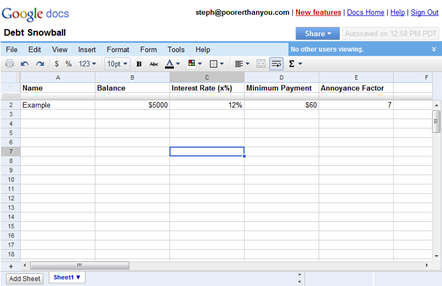
Theory #3: The Annoyance Ranking
I promised you an alternate theory, and here it is: Rank your debts in the order that they annoy you to have to pay, from “most annoying” to “least annoying,” and pay off the annoying ones first. The idea is that when the bills come, there are some bills that make you groan and moan more than others.

Let’s take The Boyfriend for example. He has two debts: his car loan, and his credit card debt. The Boyfriend loves his car to pieces, and doesn’t really mind making his loan payments every month. But his credit card? He hates it with a fiery passion. He curses it while shaking his fist up at the sky.

Basically, his credit card debt annoys the crap out of him. So, accord to my Annoyance Debt Snowball Plan, he should pay that one off first.

Why is this a good plan? Because, like the “Low Balance” theory, it plays to your human psychology. The top debts are making you more unhappy than the bottom debts, so pay them off first. Also, since you’re more likely to be annoyed by high interest debts than low interest debts, it takes the “High Interest” theory into account as well.

This theory is also good for when you have personal debts, especially family debts. These debts may be low balance and low interest, which would normally rank low in a debt snowball. But you probably feel a large amount of guilt over these debts, which would make them annoying. Putting them at the top of the ranking, and paying them first, will help improve your family relations, and perhaps prevent you from being shot in both kneecaps and lit on fire.

Pros:

Be rid of debts that make you unhappy.

Math usually works since high interest debts are more likely to be more annoying.

Con:

Math might not work, may end up paying more interest.

Feel free to add more “pros and cons” in the comments if you think of any!

Related Posts
Reader Question: Debt Consolidation Loan?
The Debt Snowball Plan
Savings Snowball in Action
Welcome New York Times Readers!
Carnival of Personal Finance at Stock Market Beat