Editor’s note: Today’s Making Do essay comes from a writer who would like to be known as Magdalene A. to protect their privacy. This piece contains mentions (but no detailed descriptions) of topics that may be triggering for some readers.
We don’t like to think that death could be a good thing, especially if it involves someone close to us. When someone dies, the most common, natural, and appropriate reactions are shock and sadness. Even with the belief that death can end suffering, and the understanding that it is a natural part of life, the notion that someone must die so another can live doesn’t sit right with most people.
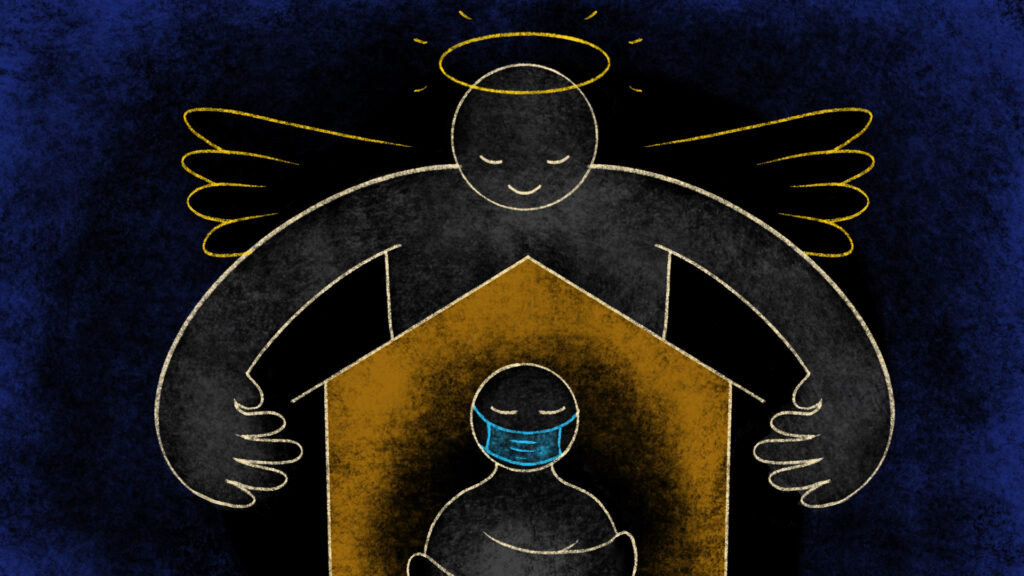
Yet that’s precisely what had occurred in my family before the pandemic. My father’s death ended up giving me grace to survive.
In 2012 my life started deteriorating. Over the next several years, I watched as many of my dreams crashed and burned along with my mental health. I had already experienced a difficult and traumatic childhood in some ways, and I stayed alive with the hope that things would be different as an adult.
Yet unfortunately during much of my 20s and so far into my 30s, I have endured more trauma. I have frequently found myself underemployed, broke, in abusive situations, and even homeless. I endured multiple stays in the psych ward and relied heavily on my family financially. I was eventually given diagnoses of Asperger’s syndrome and a couple other psychiatric disorders. While this partially explained why things had been hard for me, it didn’t necessarily make them better.
In 2019 things took a turn for the worse. My family and I underwent numerous highly stressful and tragic events, including the death of my father. To make matters more difficult and complicated, he had not left a living will that we could find. My mother, whom he had been divorced from for years, had to pay for his funeral and take charge of his estate, including his house, his money, and all of his possessions. Everything wound up in probate. All of this caused major rifts in my already dysfunctional family, to the point I couldn’t be in the same room as one of my siblings.
I didn’t know how to cope with life anymore, let alone the death of a parent and the subsequent mess that had been created.
In February of 2020, after being sexually and physically harassed during a dream job interview, I lost almost all hope for my life. I attempted suicide, and was hospitalized in the ER and yet another psychiatric ward. Afterwards I remember being told by different people to “hang on” and that “you never know what is around the corner.” Yet given my state of mind at the time, I would have been even more convinced that death was the better option if I knew a global crisis was in the midst.
The one silver lining in all of this was the fact that my father’s house remained livable and empty. Once Covid-19 took hold of the world, I was able to quarantine there by myself, avoid getting sick, as well as avoid the increasing tensions in my family and the world in general. Serendipitously, the house wound up being stuck in probate for nearly the same amount of time most major Covid restrictions were in place.
My father’s death in his mid-60’s wasn’t entirely expected, but it wasn’t entirely a shock either. Over the years his health had deteriorated like mine, but for different reasons. He’d had a myriad of injuries and illnesses, including Multiple Sclerosis, and was mostly bedridden.
While he had never been officially diagnosed, he also had characteristics of Asperger’s/Autism Spectrum Disorder, Bipolar disorder, and more, which is no doubt where my siblings and I got our issues from.
Unfortunately, this meant he could be a difficult and even very abusive person at times. But I never prayed for him to die or felt his death would be a blessing. He had his good side, and he had helped support me in many ways. He reminded me often that “he would lay down his life for me.”
To this day, his death has left me confused, feeling like a part of my identity is missing and never to return. I occasionally find myself overcome with grief when I least expect it. I also try to remain grateful, knowing some of the most interesting aspects of myself come from him.
Receiving a monetary inheritance after my father’s death had even been a bit of a joke between me and him when he was alive. My father’s sense of humor (and the one I inherited from him) could be very morbid and bizarre. His unique personality was in fact what gave him life in my eyes, and I always associated its disappearance with his real death. But until his last couple days, he maintained the same crass and quirky demeanor. It was his poor physical condition that determined his fate. He would’ve lived likely 20 more years if he had taken better care of himself and hadn’t been so sick.
Though there were legal and financial hurdles as far as the estate after his death, I eventually found out I would be getting a good sum of money. This was the one thing I held on to that gave me some hope during the dark days of the pandemic. I looked forward to the possibility of buying my own place somewhere far off, growing my own food, paying off debt, and perhaps trying different kinds of therapy I wasn’t able to access or afford otherwise.
Like many people the world over during the pandemic, my financial situation became a bit dire, and I was far from an “essential worker.” I was lucky I had managed to get on disability a couple years prior, but I was only able to get a few hundred dollars a month. I even still worked off and on as a freelance writer, but the earnings were far from enough, and everything dried up months into the spread of Covid-19. My total earnings were barely enough for living expenses in the USA.
And the sad thing was, I had even had to fight for over a year to get the disability, which is the experience of most Americans, including those who are way worse off than me. I applied three times, hired a lawyer (who ended up taking a portion of the back pay I was offered), and had to be seen by a judge.
During this entire time I had to live with and depend on mostly my mother, stepdad, and one of my sisters. If they had said no, I have no idea where I would have gone. My father was totally reliant on certified caregivers and dealing with his own problems.
While I was lucky to have housing, life at my mother’s house was chaos. There was hoarding, codependency, enmeshment, constant fighting, verbal abuse, and even law enforcement involvement. And it had always been this way, I just hadn’t fully understood until getting intense therapy years later. It was likely some of the reason for my own mental health issues, and truly escaping it would seem to take a miracle.
My father’s empty house essentially became a refuge for me. Even though it wasn’t sanitary, and there were all kinds of issues like leaks, infestations, and more, I had a semblance of peace. I felt renewed and alive knowing that I would be able to escape from and improve my circumstances, which was more than many with similar issues could say.
People I knew that didn’t have disability income or a place to go to quarantine were hungry, living in their cars, stranded in foreign countries, and forced to reside with abusive individuals. I do not want to think of what happened to several people I met in the psych ward prior to Covid who were sicker than I was mentally and physically. And some of them had children dependent on them. I witnessed several Facebook groups form that were filled with thousands of individuals asking for help because they couldn’t get what they needed due to already overwhelmed resources.
If it weren’t for the house and the financial security I was offered through the inheritance, I could have ended up quarantined indefinitely in a psych ward, shelter, or on the street.
Given what I’ve seen and experienced in many psych wards, having to stay there during Covid for possibly months at a time would be hell on earth. I don’t even want to imagine what it would have been like to stay in a prison, shelter, or refugee camp. Even though it was sometimes very isolating in my father’s house, I could entertain myself with take-out, the World Wide Web, and going outside.
At one point, my mother and stepdad ended up both getting Covid-19. A sister who lived with them was considered immunocompromised, but had nowhere else to go to quarantine and thus risked getting sick.
I was diagnosed as borderline Diabetic amidst the pandemic, and was also overweight. I feared that getting Covid could mean complications or worse. If I’d had to stay with them and gotten sick, there’s no telling how bad it could have been. Then you add in pre-existing mental health issues and Asperger’s/Autism Spectrum Disorder, which for me meant the masks and restrictions further hampered my social struggles and sensory issues.
But I survived. I’m able to invest and maintain a nest egg while many have been financially devastated. I got to travel outside the country eventually, while some haven’t been able to leave the city or building in which they were forced to quarantine. I was even able to help other people.
But none of this would’ve been possible if not for my father’s death. While he likely wouldn’t have made it through most of Covid, he would have still had to spend a significant amount more on additional caregiving and health measures, and would have suffered even more pain and anguish.
Another sad truth is that if I had stayed with him at his house, I could’ve risked getting him sick or myself sick. I also know that gaining stability and security from his estate during a very unstable and insecure time prevented me from attempting suicide again.
In a wealthy and industrialized nation like the USA which prides itself on being the land of opportunity and freedom, the most vulnerable shouldn’t have to be subjected to any of this. Many of those who were marginalized before the pandemic ended up even more marginalized after, which sometimes meant death. This is despicable, and points to failure on multiple levels.
I’m hoping that the positive outcome from Covid will be a global wake up call to humanity. I hope it is a chance for us all to consider that food, housing, and medical care shouldn’t be luxuries, and that your ability to make money in an industrialized, market economy (which is destroying the planet) isn’t more important than you and your fellow human’s basic survival.
Editor’s Note: This essay was paid for and presented as a part of the Making Do Project, a Poorer Than You initiative to provide a space for low income, unemployed, or underemployed folks to share their money stories. Both the author and illustrator who contributed to this piece were compensated for their work. Visit the Making Do Project to learn how you can contribute to the project with an essay, art, or a monetary contribution to support the work.