Rethinking my Bank Accounts

Filed under: Checking — by Stephanie on February 13, 2008 @ 1:28 pm

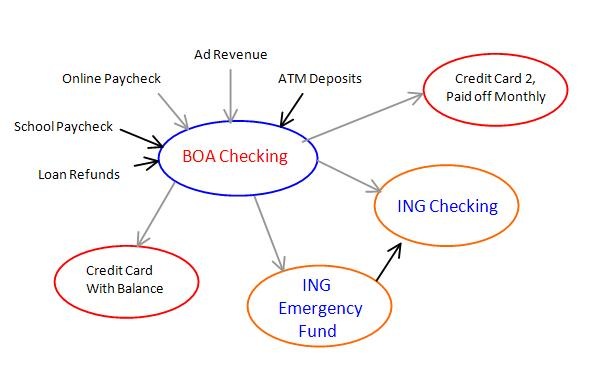
With the addition of an ING Checking account and a free and clear credit card to my banking arsenal, it became clear to me that I needed a different plan of attack for how I’m doing my banking. To show you what I mean, here’s a diagram of how I was doing things:

oldbanking

The black arrows represent near-immediate deposits or transfers, which take only a day or so. The gray arrows are slower deposits or transfers, which typically take three days or more.

So, if you look at the diagram that I crudely constructed, you’ll see that all of my income and deposits came into my Bank of America checking account, and then largely sat there, until either being moved to one of ING accounts, or used to pay one of my two credit cards.

Note: nearly all of my purchases are made using Credit Card 2, to earn rewards points and offset my purchases by one month before I pay the bill in full.

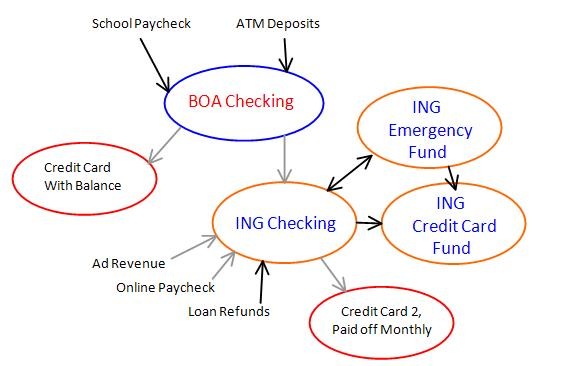
So what’s the problem with this? Convenience-wise, not a whole lot, except that the Bank of America checking account doesn’t earn me any interest, and that’s where most of my money was sitting most of the time. So I decided to entirely rework things, and came up with this new setup:

newbanking

Ok, so, the paycheck from my on-campus job still direct deposits into my BoA account, and it’s still the convenient account for depositing checks at the ATM. But I’m quickly moving that money from BoA to my ING Checking account, so that it can earn interest, leaving only enough in my BoA account to pay the minimum payment on the credit card with the balance.

“Only the minimum payment?!?” you cry out, in shock and alarm. But, you will see that I’ve also got a new ING account in this setup. ING allows you to set up multiple savings accounts with minimal work and as quickly as humanly possible - I timed how long it took me to setup my new Credit Card Fund savings account, and it came out to 42 seconds!

Instead of making payments to the card itself, I’m now putting aside $140 of my monthly $160 payment (the other $20 is the minimum payment I make directly to the card) in the new savings account to earn interest. Then, the month before my 0% APR period ends, I will take all of the money in the account and pay off the credit card in full.

NOTE: This “paying your card off in your savings account” only works if you meet two conditions:

A) Your credit card interest rate has to be lower than your savings account interest rate. My savings account earns nearly 4%, and my credit card is at 0% for now, so it works. If your credit card interest rate is MORE than the card, then you should just pay off the card directly.


B) You treat payments into the savings account just like any other bill. You make the payments regularly, on time, and in the full amount. More importantly, do not take the money out of the account for any other purpose! Although it can technically serve as a second emergency fund, taking money out of the account is just the same as putting purchases on your credit card - it will completely counteract your credit card payoff efforts.

So, what are the advantages to my new setup, over the old one?

  1. Interest, interest, interest. I’ve got much higher balance in my ING checking this way, so that’s earning much more interest. And I’m earning interest on the credit card payoff account, as well. Altogether, I’ve calculated this setup will earn me an extra $60 in interest this year. Which may not seem like a lot to some of you, but to me? A poor college student? That’s some serious gains just for rearranging my accounts!
  2. Faster transfers. If it looks like there are more black lines in the second diagram, that’s because there are. Using mainly only ING accounts means instant transfers between three of my accounts - not even 1 day transfers, but instant!
  3. Shows my undying adoration for ING. Sure, they don’t have the best interest rates around, but they’re still competitive, and I love them to pieces. Plus, I made as much money from their referral program last year as I did working my on-campus job for the fall! Out of the four high-yield accounts I have (the others being E*TRADE, Emigrant, and Citibank), I like ING’s interface and usability the best.

All in all, it might seem like I’m a little crazy to obsess over such minute details, but I figure it probably only took me a half an hour of work, and netted me $60, so that’s an hourly rate of $120! Not bad at all!

Anyone else have any little “bank life hacks” like this?

Related Posts
Net Worth Update: February 2008
Back to Basics #3: Checking Accounts
Back to Basics #2: Savings Accounts
How Much Interest Would $1,000,000 Yield?
The Blog Apocalypse: My Final Post

Financial Aid Refund - What Do I Do With It?

Filed under: Checking, College — by Stephanie on September 25, 2007 @ 9:37 am

It’s Student Loan Refund Open Season, and the line at Student Financial Services is about to get pretty long. For college freshman and anyone else who might not know what I’m talking about, Student Loan Refunds occur when you get more money from your financial aid than your school needs for your tuition and other billable expenses. And then they cut you a check for the difference.

So what’s to be done with this sudden, extra, seemingly-free money? “BUY BOOZE!” you say. And that’s a valid use of it (also not the best use of it), but I’m not necessarily talking about what you should spend it on. I’m talking about where you should put it.

You’re probably already making out the deposit slip to drop in your usual checking account at your brick-and-mortar bank. But is that really the best place for your money?

In a checking account, your money is basically just going to sit in the account until you’ve depleted it. Even in a regular savings account, it’s probably not going to earn more than .2% interest (a fifth of a percent). And sure, interest is good, but how much money is .2%, really?

What’s the average you get back on a refund check? I don’t know, but I’ve never gotten more than $350. Some people actually get enough from their checks to pay for their off-campus room and board for the semester, so it might be a lot higher, like $2,000. So let’s just use $500 for the example, because it’s nice and round.

So $500 in your savings account earning .2%. Now that $500 isn’t going to stay there for a solid year, but let’s pretend it did. After a year, you would have earned… *drum roll please…*

$1.00

Wow, that hardly seems worth it. In fact, considering you’ll deplete that $500, and won’t even earn a whole dollar, it doesn’t seem worth it at all to put it in the savings account instead of the checking.

But hold up - I’ve got an idea. In fact, it’s what I’ve done with this term’s refund already. Are you interested? I’ll be getting a 3.5% (not 3/10ths of a percent, a whole 3.5 percent) return on my refunds. And I got a $25 bonus.

So how much of a difference can 3.5% and a $25 bonus make? Well, to start with, there’s that $25 bonus. So we’re up to $525 in our example already. And $525 at 3.5% for the year would be… *drum roll again…*

$18.37 - putting the total up to $543.37. Without breaking a sweat.

Alright, alright, so you’re sold on the 3.5% with a $25 bonus idea - where can you get it? ING Direct’s Electric Orange Checking account. It works just like a regular checking account, with a few differences:

  1. You get a 4% APY on money sitting in the checking account. You can also open a Orange Savings account with them, and link the accounts together. Money in the savings account earns 4.3%.
  2. The account comes with a debit card, but no check book. If you need to send a check, they have an electric check system - or you can move the money to your brick-and-mortar checking account (so don’t cancel your old account!)
  3. You get an Overdraft Line of Credit instead of “courtesy overdraft protections” - that thing where when your account drops below $0.00, instead of declining your purchase, your bank graciously lets the charge go through and then slaps you with a $35 fee? Yeah, instead of charging a flat, outrageous fee, ING charges a normal interest rate on the amount your account went below $0.00. If you manage to make a deposit in the next few days to bring the account back into the positive, you’d only be charged pennies - instead of $35.
  4. You get a $25 bonus if you open the account with a referral link and your opening deposit is $250 or more.

So that refund check sitting in your checking account? The one that’s probably for $250 or more? Go open an account with it. Remember how I said you could move money from ING to your brick-and-mortar checking account? That link works both ways - you can move $250 from your regular checking to ING for the opening deposit.

So whether you’re saving this refund for next term’s textbooks, or you’re slowly draining it for expenses - it doesn’t really matter. Either way, you should be making some money off of it while it sits in your account. 

Related Posts
Finally, I Can Do My Taxes!
Financial Aid Results
Financial Aid Dilemma Resolved
Financial Aid Dilemma
Dependent or Not Dependent: Why I Hate the FAFSA

ING Direct Orange Savings and Electric Orange Referrals

Filed under: Checking, Savings — by Stephanie on September 21, 2007 @ 12:19 pm

ING referrals have moved here: $25 ING Referrals. Sorry about the inconvenience, but it was a bit of a pain to upkeep two pages of referral links!

Related Posts
Get $25 from ING Direct
How Much Interest Would $1,000,000 Yield?
My Struggle With Emigrant
ING Giveaway Results
Net Worth Update: September 2007

Back to Basics #3: Checking Accounts

Filed under: Back To Basics, Checking — by Stephanie on April 2, 2007 @ 1:34 pm

Savings accounts are cool and all, but sometimes, you actually want to be able to exchange your money for goods and services. Checking accounts make this easy to do, by allowing you to fill out a little form, appropriately named a “check,” handing over some of the money in your account to someone else.

No Interest?
Although, just like in a savings account, the bank is borrowing your money, they don’t pay you any interest on it. Your money sits there and doesn’t grow at all. This is almost like a “fee,” you’re forgoing the interest in favor of easy access to your money - at least, in most cases. Some banks have checking accounts where if you keep enough money in the account (usually north of $5,000), they’ll pay a very small amount of interest on it.

New technologies have profoundly changed the way we use checking accounts. Debit cards, which are basically the hybrid of a check and a credit card, allow you to easy spend money out of your checking account. They’re also a nice way for the bank to try and get more of your money.

Overdrafts
If you draw out more money from your checking account than you actually have in there, you’ve done something called “overdraft.” There’s a series of different ways the bank might handle this, but most of them involve charging you a fee of some kind.

One thing you can do is have your bank set it up so that if you overdraft, the bank can just take the extra money out of your savings account. But the best solution is simply to pay attention to how much money you have in the account, and not spend more than that. Seriously, it’s not that hard, especially now that you can check you balance from home, using the computer, as many times a day as you want.

Checking on the Interwebs
The other technology transforming checking accounts is online bill-pay and echecks. Using just the account information for your checking account, you can pay many businesses online, including most of your bills. It’s gotten to the point where many people don’t even use paper checks anymore.

Which is where the online banks are starting to swoop in. If you no longer need paper checks, then you can get an online checking account. ING recently rolled out their online checking account, “Electric Orange,” which can be used for online bill-pay and echecks, and comes with a debit card, but no paper checks. However, you can contact ING and they will issue a paper check (for example, to your landlord). Still, the account pays 3+% interest on money sitting there. For the time being, this account is only open to customers who have an ING Orange Savings* account, but that’s easy to get, with no fees or minimums.

My philosophy when it comes to my checking account: don’t let money sit in there, earning no interest, if I don’t have to. I only keep enough in there for what I’m going to need in the next two weeks.

*Affliate link. Because I can.

Related Posts
Get $25 from ING Direct
Back to Basics #0: Introduction
Back to Basics #2: Savings Accounts
Citibank $100 Bonus Up Again
Financial Breakdown